
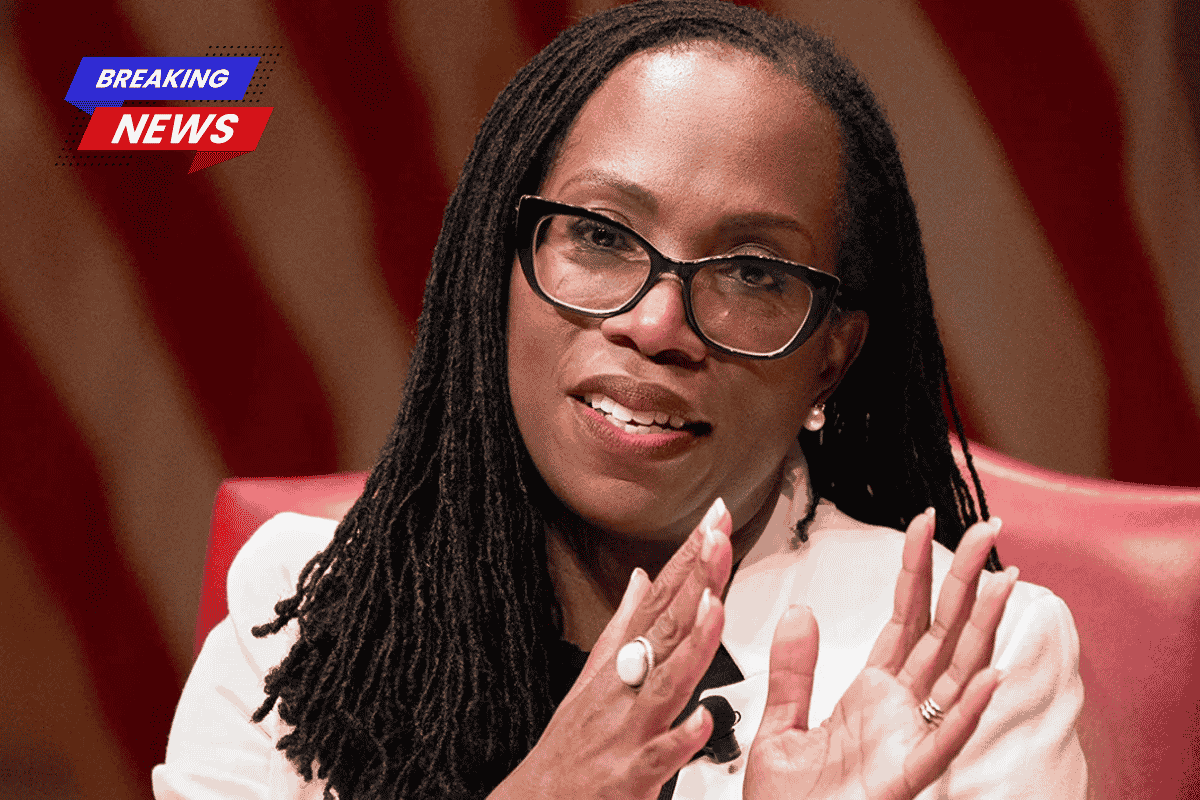
Justice Ketanji Brown Jackson, appointed by President Joe Biden, has increasingly found herself on an island as she stands in opposition to many of her colleagues on key high-profile cases.
Known for her solo dissents, Jackson has been vocal in her criticism of the Supreme Court’s decisions, often challenging what she sees as overreach by the Court and emphasizing her concern for civil rights and judicial integrity.
A Pattern of Lone Dissents
Jackson’s dissenting opinions have often been a vocal outcry against what she believes to be the Court’s overstep in various cases, especially those concerning executive actions during President Donald Trump’s administration.
Her positions have drawn significant rebukes from her conservative colleagues, highlighting a deeper ideological divide within the Court’s liberal bloc.
1. Louisiana Redistricting Judgment
In a landmark ruling on Louisiana’s congressional map, the Supreme Court found 6-3 that the state’s districting plan contained an unconstitutional racial gerrymander. The Court acted swiftly, fast-tracking the decision and handing it down immediately, rather than waiting for the usual timeframe.
Jackson, in her dissent, argued that the Court should not have “dove into the fray” by influencing elections through such a hasty ruling. She expressed concern that the Court’s actions were meant to influence how the redistricting was implemented, not just interpret the law.
Justice Samuel Alito, joined by Justices Clarence Thomas and Neil Gorsuch, sharply criticized Jackson’s dissent, calling her claims “groundless and utterly irresponsible.”
2. Universal Injunctions
In another case involving Trump’s policy on birthright citizenship, the Court ruled 6-3 to ban nationwide injunctions, a method often used by lower courts to block executive actions across the country. Jackson disagreed, writing that nationwide injunctions should be permissible as a means of preventing unconstitutional actions by the president.
Her dissent was sharply criticized by Justice Amy Coney Barrett, who suggested Jackson’s position conflicted with centuries of precedent and the Constitution itself, accusing Jackson of advocating for an “imperial Judiciary.”
3. National Institutes of Health Grants
Jackson’s frustration boiled over in a case concerning the cancellation of nearly $800 million in research grants by the National Institutes of Health under the Trump administration.
In a dissenting opinion, Jackson condemned the majority’s stance, accusing them of bending over backward to accommodate the Trump administration. She likened the legal reasoning to “Calvinball jurisprudence,” suggesting that the Court had abandoned any fixed rules, with the Trump administration always winning.
She argued that the grants were vital for important research, especially in the fields of diversity, equity, and inclusion, COVID-19, and gender identity.
4. Colorado Conversion Therapy Case
In a case involving a Christian counselor challenging Colorado’s ban on conversion therapy, Jackson was the lone dissenter, warning that the decision would have unforeseen consequences. The Court sided 8-1 with the counselor, but Jackson believed that the ruling contradicted established medical standards.
Her dissent, which was rejected by Justice Elena Kagan, raised concerns that the decision would undermine the medical profession’s stance on treatment for minors regarding sexual orientation and gender identity.
5. Reasonable Suspicion for Police Stops
In April, Jackson dissented in a case where the Supreme Court reversed a lower court ruling involving the Washington D.C. police and the detention of a man in a suspicious vehicle. The Court found that the officer’s decision to detain the man was justified based on the “totality of the circumstances.”
Jackson criticized the majority for “wordsmithing” and interfering with a routine assessment of a police stop, questioning why the Court felt the need to intervene in a typically fact-based determination. Justice Sonia Sotomayor, while also dissenting, chose not to join Jackson’s opinion.
Jackson’s Radical Jurisprudence?
Despite her growing reputation as an outlier, Jackson has garnered significant support from civil rights groups and progressive communities. Her stance on judicial issues, particularly on human rights and executive overreach, has made her a divisive figure on the Court.
George Washington University law professor Jonathan Turley criticized Jackson’s dissents, calling her judicial approach “radical” and “chilling.”
On the other hand, Jackson has received widespread praise for her positions, with celebrities and Democratic lawmakers offering their support. She has been lauded for her determination to stand firm in her beliefs, even if they lead to isolation on the Court.
During an appearance on The View, Jackson responded to criticism by noting that dissent is an important part of the judicial process. “Dissents are an opportunity for the justices who disagree with the majority to really describe their view of the law but also their concerns,” she explained.






