The small city of Westwego, located on the west bank of the Mississippi River within Jefferson Parish, has a unique name with a rich history. One reader’s question prompted a closer look at how Westwego got its name and the story behind its development.
Early Maritime Roots
Westwego’s history dates back to a thriving maritime industry. In the 1830s, the Louisiana Legislature chartered the Barataria and Lafourche Canal Company to dig a channel. This ambitious project created a navigable waterway running from the Mississippi River all the way up to present-day Morgan City, passing through Bayou Segnette and connecting with other lakes, channels, and bayous.
As the company made its way to Bayou Lafourche, a lock was built to create the Company Canal waterway. The area’s maritime industry began to grow, and workers drawn by trade became familiar with the area. This early development laid the groundwork for future expansion.
The Railroad and the Naming of Westwego
Though the area’s maritime industry established early roots, Westwego owes its name and significant population growth to later developments, particularly the expansion of the railroad industry.
John Churchill Chase, a New Orleans native, chronicled this in his book Frenchmen, Desire, Good Children and Other Streets of New Orleans. By 1870, the New Orleans, Mobile & Chattanooga Railroad had completed a line to Mobile, but instead of continuing on to Chattanooga, the company decided to expand westward toward Texas.
The New Orleans, Mobile & Texas Railroad sought a site for a terminus with docks, wharves, and other infrastructure necessary for a railroad ferry. A plantation was purchased for this purpose and renamed Amesville. Unfortunately, the riverbank at Amesville was found to be unstable and unsuitable for construction, and a new site was needed.
The Company Canal and the Birth of Westwego
The area near Company Canal, with its stable riverbank, was identified as a more suitable location. The Westwego terminus was built there, and by 1871, construction of the western railroad line had begun.
There are several theories about how the settlement was named. One popular version suggests that railroad conductors shouted “West-We-Go” as the trains departed for the western route.
John Churchill Chase, however, offers a different theory. He writes that the name arose from a series of meetings by the railroad’s board of directors in New York. After discovering that Amesville was unsuitable, the engineers recommended Company Canal as the new location. In response, the board directors reportedly declared, “Then west we go from here!”
Westwego Becomes Official
The name “Westwego” began to appear in local newspapers, with the earliest documented use appearing in The Times-Picayune on July 19, 1872. The report highlighted the completion of the New Orleans, Mobile & Texas Railroad’s main stem from Westwego to Donaldsonville.
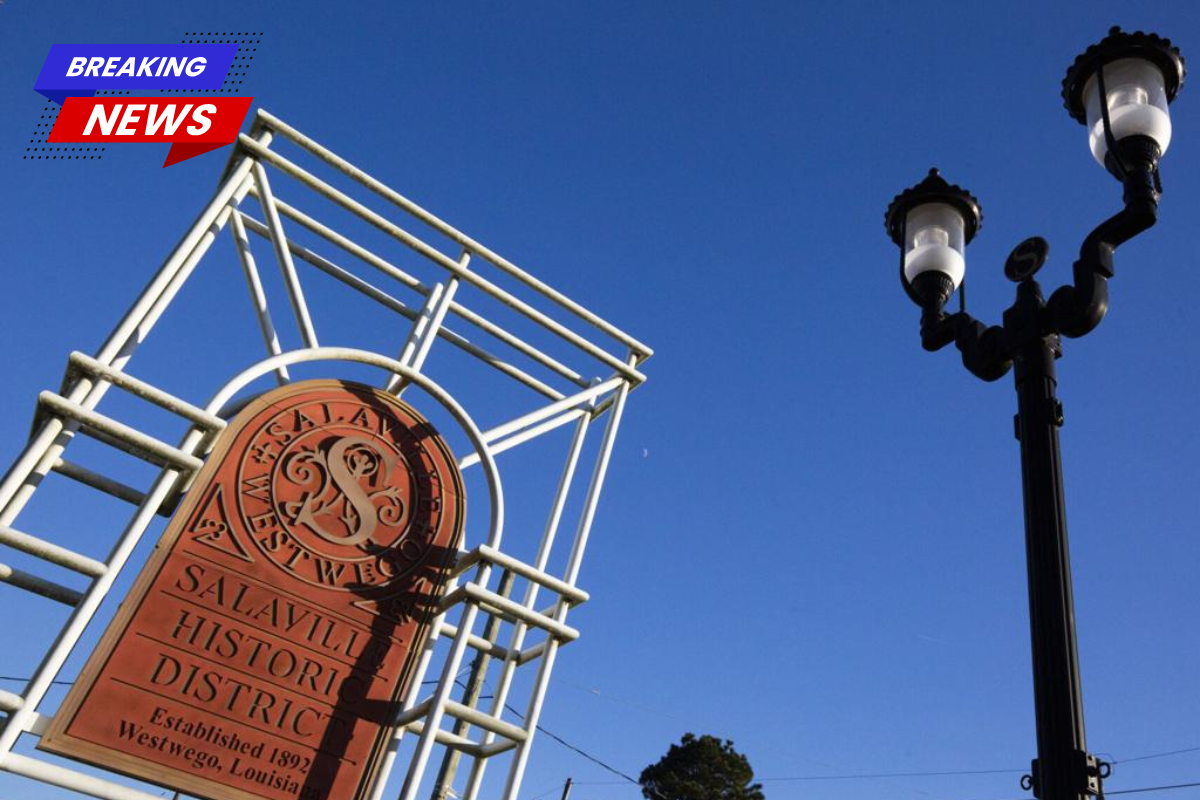
Although the name “Westwego” became well-known, it took time for the area to grow into a city. In 1892, entrepreneur Pablo Sala purchased land on the lower side of Company Canal and subdivided it into 162 plots, naming the area “Salaville.” After a 1893 hurricane devastated the nearby fishing community of Cheniere Caminida, many residents relocated to Salaville, swelling its population.
By 1919, the settlement that had become widely known as Westwego was formally incorporated as the “Village of Westwego.