
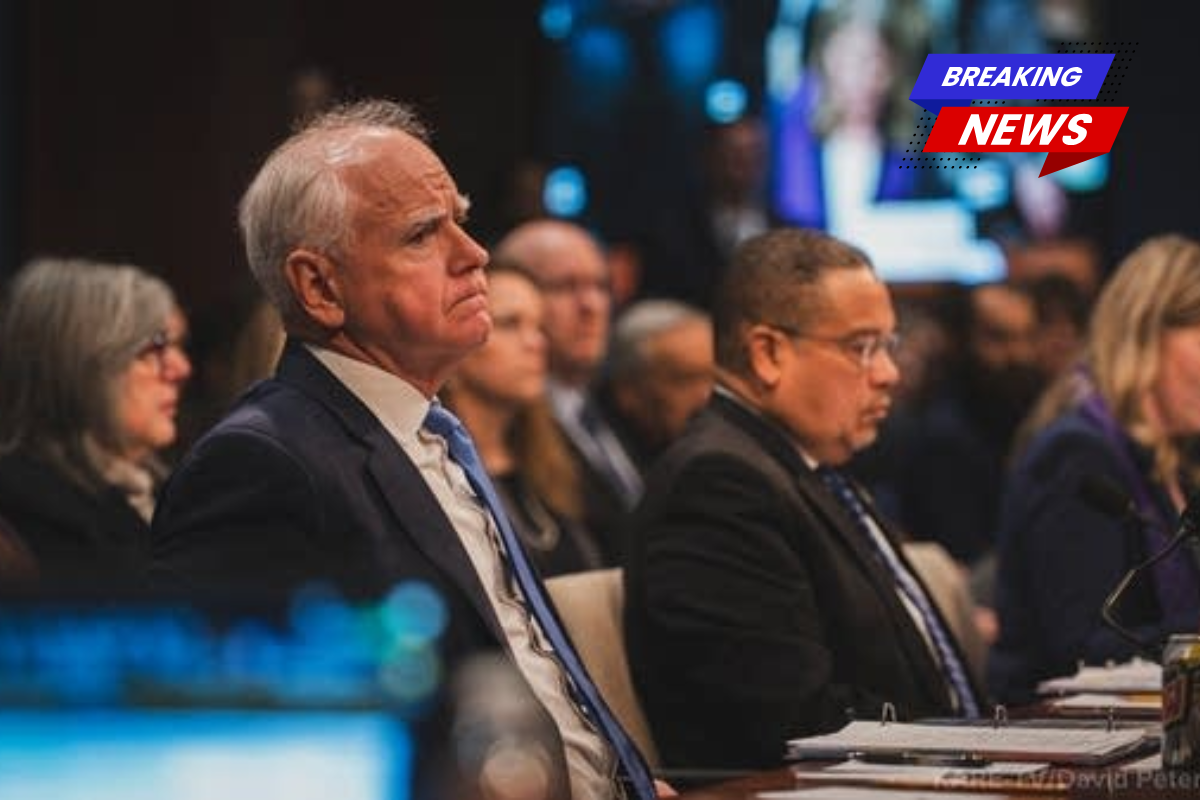
Minnesota Governor Tim Walz and State Attorney General Keith Ellison appeared before the House Oversight Committee on Wednesday, where lawmakers questioned them about a major fraud scandal in the state as well as the Trump administration’s recent immigration enforcement surge in Minnesota.
The hearing quickly became politically charged, with Republicans focusing on allegations of fraud involving state programs, while Democrats used the session to criticize the federal government’s immigration crackdown.
House Oversight Hearing Focuses on Minnesota Fraud Scandal
The House Oversight Committee released a report before the hearing accusing Walz and Ellison of failing to properly address a massive fraud scheme connected to a nonprofit organization called Feeding Our Future.
Republican lawmakers claimed the Minnesota Department of Education allowed funds to flow into what they described as a $250 million fraud operation despite identifying serious problems in the program.
Committee Chairman James Comer said documents and testimony suggested state leaders were aware of potential fraud but did not act quickly enough.
He also alleged that officials who raised concerns were retaliated against.
During the hearing, Walz acknowledged the fraud occurred while he was governor.
However, he defended his administration’s response and said state officials cooperated with federal investigators throughout the investigation.
Walz and Ellison Questioned About Knowledge of Fraud
Republican lawmakers repeatedly asked both Walz and Ellison when they first became aware of the fraud allegations and what actions they took afterward.
Representative Tom Emmer questioned Ellison about a meeting he held in December 2021 with staff from Feeding Our Future, the nonprofit at the center of the scandal.
Emmer asked Ellison when he personally became aware that the FBI had launched an investigation into the organization.
Before Ellison could fully respond, Emmer demanded that both Walz and Ellison participate in sworn depositions to further examine their roles in the matter.
Republicans argued that the key question remains what state leaders knew about the fraud and when they learned about it.
Tense Exchanges During the Hearing
The hearing included several heated exchanges between lawmakers and the Minnesota officials.
South Carolina Representative Nancy Mace accused Walz of not being fully prepared to answer questions about state spending on autism programs.
She claimed that funding for autism-related services in Minnesota increased sharply from about $1 million in 2017 to $343 million in 2024.
Walz responded by saying he would not serve as a political prop during the hearing.
In another tense moment, Louisiana Representative Clay Higgins called on Attorney General Ellison to resign.
Higgins argued that Ellison was not showing enough leadership in addressing fraud within the state.
Ellison defended his office, saying his team works aggressively despite having limited jurisdiction over some investigations.
Walz Criticizes Federal Immigration Crackdown
While Republicans focused on fraud allegations, Walz used part of his testimony to criticize the Trump administration’s immigration enforcement actions in Minnesota.
He said the federal government had deployed large numbers of agents into the state under what officials called Operation Metro Surge.
According to Walz, the operation was presented as an effort to fight fraud but instead disrupted local communities and ongoing investigations.
He said the presence of federal agents led to several resignations within the local U.S. Attorney’s Office, which he warned could slow down fraud prosecutions.
Walz suggested that the federal government should instead prioritize appointing prosecutors to handle fraud cases.
Attorney General Ellison Raises Economic Concerns
Attorney General Keith Ellison echoed Walz’s criticism of the federal immigration enforcement surge.
Ellison said Operation Metro Surge did not help address fraud in Minnesota and instead caused economic harm.
He argued that the operation disrupted businesses and communities while doing little to solve the state’s fraud issues.
Both officials maintained that Minnesota’s social service programs generally function well but acknowledged that no system is completely immune from fraud.
Religious Leader Testifies Against Immigration Operation
Reverend Mariah Tollgaard, a senior pastor from Hamline Church United Methodist in St. Paul, also testified during the hearing.
She appeared as a witness invited by Democratic members of the committee.
Tollgaard spoke about the impact of federal immigration enforcement in local communities.
She said some children in Minnesota schools are now practicing drills not only for active shooter situations but also for possible immigration enforcement actions.
According to Tollgaard, such measures create fear and anxiety among families.
Democrats Criticize Federal Immigration Policies
Democratic lawmakers focused much of their questioning on the Trump administration’s immigration policies.
Representative Robert Garcia, the committee’s ranking Democrat, accused the administration of using fraud investigations as a justification for expanding immigration enforcement.
Garcia said the federal government had reduced funding for programs such as food assistance and health care while significantly expanding immigration enforcement operations.
Several Democrats also referenced the deaths of two individuals, Renee Good and Alex Pretti, who were killed during a confrontation with federal officers.
They criticized Homeland Security Secretary Kristi Noem, who had earlier described the incident as related to domestic terrorism.
Democrats Call for Additional Subpoenas
Some Democratic lawmakers pushed for further investigations into federal immigration enforcement.
Representative Raja Krishnamoorthi proposed issuing a subpoena for Homeland Security Secretary Kristi Noem, alleging problems within her department.
Another Democrat, Representative Wesley Bell of Missouri, called for a subpoena targeting Greg Bovino, the Border Patrol commander who led Operation Metro Surge.
Both proposals reflected growing tension between Democratic lawmakers and the administration over immigration enforcement tactics.






