Understanding your knife rights in Maine is crucial for residents, visitors, and outdoor enthusiasts, as the state maintains some of the most permissive laws in the U.S. while emphasizing responsible use.
With no statewide preemption, local rules can vary, but core statutes focus on carry methods rather than outright bans. This guide breaks down ownership, carry options, restrictions, and penalties under 2026 laws.
Overview of Maine Knife Laws
Maine rates as moderate for knife regulations, allowing broad ownership of common types like folders, fixed blades, and switchblades since a 2015 repeal of prior bans. Key statute 25 M.R.S.A. § 2001-A prohibits concealed carry or threatening display of “dangerous or deadly weapons usually employed in the attack on or defense of a person,” such as bowie knives, dirks, or stilettos. Hunting, fishing, or utility knives escape this if not designed for combat.
No blade length limits apply statewide, unlike many states. Open carry remains fully legal for all knives, reflecting Maine’s “Live Free or Die” ethos. Local ordinances fill gaps—check municipalities like Portland or Bangor for extras, as preemption doesn’t exist.
Legal Knife Types
Most knives are permissible to own, possess, and openly carry.
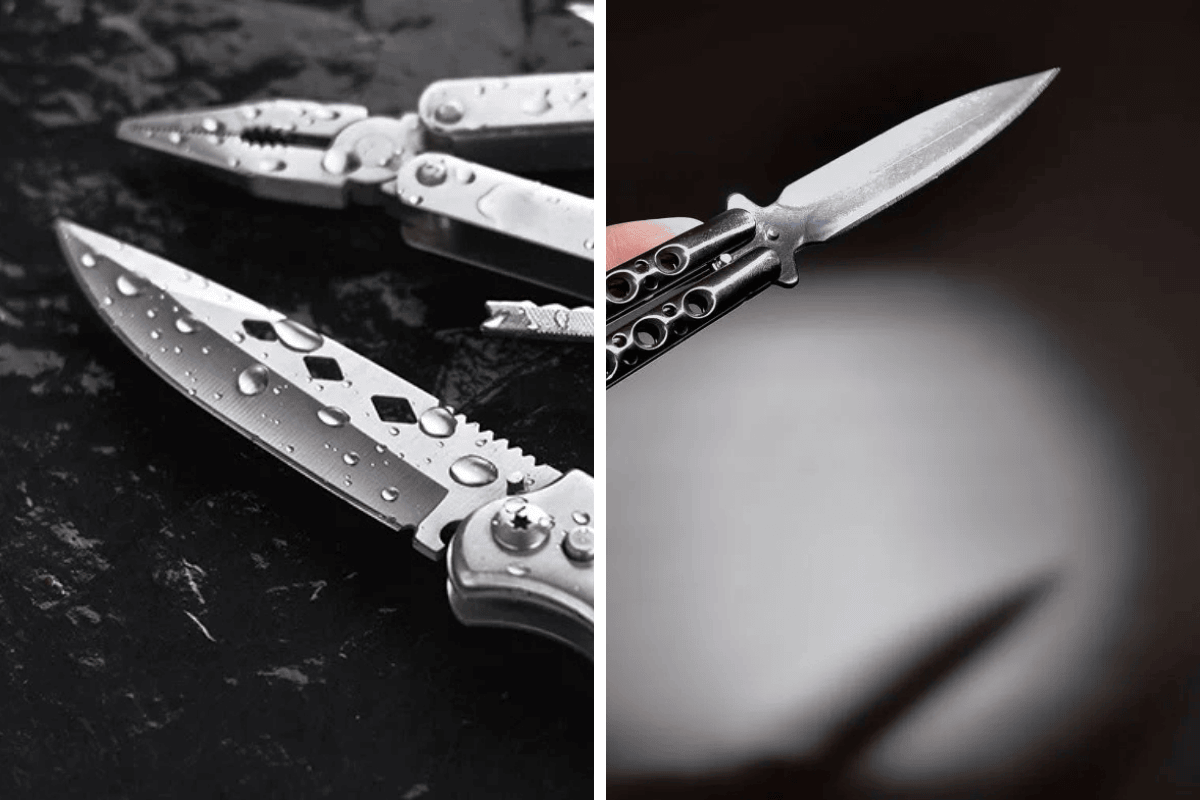
- Pocket Knives and Folders: Legal everywhere; no restrictions on manual or assisted-open models.
- Switchblades/Automatic Knives: Legal since 2015 repeal of 17-A M.R.S. § 1055; own, open carry, or conceal as non-“anti-personnel” tools.
- Fixed Blades: Bowie, hunting, or sheath knives legal openly; concealment risks if deemed “deadly.”
- Multitools: Leatherman-style tools fully legal, treated as utilities.
Unclear categories include disguised knives (e.g., cane swords), which may qualify as prohibited if concealed and combat-oriented per State v. Jones (2012). Ballistic knives face federal bans (15 U.S.C. § 1245) and likely state scrutiny under § 2001-A.
| Knife Type | Ownership | Open Carry | Concealed Carry |
|---|---|---|---|
| Switchblades | Legal | Legal | Legal (utility use) |
| Bowie/Dirk | Legal | Legal | Restricted |
| Pocket Knife | Legal | Legal | Legal |
| Disguised | Legal? | Case-by-case | Likely illegal |
Carry Rules: Open vs. Concealed
Open carry faces no prohibitions—clip a folder to your pocket or sheath a fixed blade on your belt without issue. Avoid “threatening manner” displays, which could trigger assault charges under § 2001-A(1)(A).
Concealed carry splits by intent: utility knives (e.g., fishing tools) are fine “under clothes or about the person,” but those “usually employed” for attack/defense—like stilettos—are banned. Courts assess “intrinsic qualities”; a work knife passes, a dagger doesn’t. One-armed individuals historically had switchblade exceptions, but that’s obsolete post-repeal.
Vehicles follow body carry rules—knives in glove boxes count as concealed.
Prohibited Locations
Knife restrictions mirror gun “sensitive places,” though less detailed:
- Schools and school grounds (federal Gun-Free School Zones Act applies analogously).
- Courthouses, jails, and police stations.
- State buildings and legislative chambers.
- Bars or alcohol-serving venues in some locals.
Private property owners set rules; businesses can ban knives. During protests or traffic stops, brandishing invites trouble—peaceable carry prevails.
Penalties and Defenses
Violations of § 2001-A are Class D crimes: up to 1 year jail, $2,000 fine. Intent matters—prosecutors must prove the knife’s “usual employment” as a weapon. Defenses include lawful hunting/fishing use or lack of concealment.
No broad law enforcement/military exemptions exist for knives, unlike firearms. Juveniles face delinquency charges; parents may lose custody in extreme cases.
Special Considerations
Travelers: Interstate highways allow carry per Maine rules; declare at borders if questioned. Airports ban all blades in secure areas (TSA rules supersede).
Hunters/Anglers: Field-dressed game justifies fixed blades, even concealed during transport.
Self-Defense: Maine’s stand-your-ground law (2007) doesn’t specify knives, but proportional force applies—escalation risks charges.
Local Variations: Portland restricts switchblades historically, though state trends liberalize; verify city codes.
Recent Changes and Advocacy
Knife Rights’ 2015 win repealed switchblade bans, aligning Maine with permissive states. No major 2026 shifts noted, but monitor LD 264 impacts. American Knife and Tool Institute (AKTI) tracks updates.
Best Practices for Compliance
- Prioritize open carry to avoid gray areas.
- Choose utility-focused designs (e.g., drop-point blades).
- Document purpose—receipts for work tools help.
- Consult attorneys for arrests; cases often drop on facts.
- Stay informed via Knife Informer or AKTI.
Responsibilities Beyond Legality
Legal carry doesn’t mean wise use. Maine’s rural vibe suits knives for camping, fishing, or chores, but urban courtesy avoids alarming others. Train safe handling—classes from NRA or local shops build skills. Report lost/stolen blades promptly.
In sum, Maine empowers knife owners with few limits, rewarding responsibility. Know § 2001-A, respect locals, and carry confidently.
SOURCES:
- https://knifeinformer.com/state-knife-laws/maine/
- https://worldpopulationreview.com/state-rankings/knife-laws-by-state