
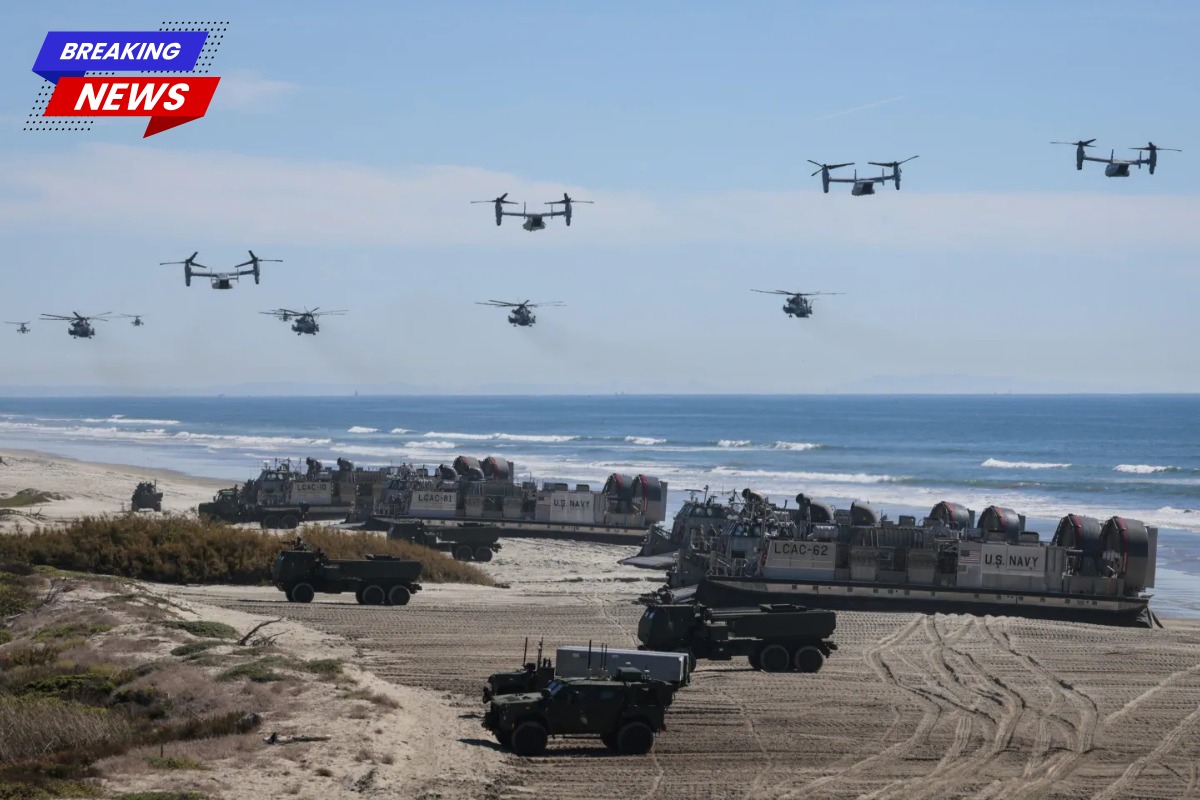
A potential showdown is brewing over control of the Strait of Hormuz, with thousands of U.S. Marines heading to the Middle East. The conflict comes after President Donald Trump issued a warning to Iran to reopen the critical waterway by Monday or face severe retaliation, including the destruction of Iranian power plants.
Escalating Threats and Responses
Iran has responded by threatening to target critical infrastructure around the Gulf, including desalination plants that supply much of the region’s fresh water. In previous statements, Trump had suggested the U.S. might escort oil tankers through the Strait, although they would still be at risk of falling within an Iranian “kill box.”
With both sides unwilling to back down, experts warn that the U.S. could expand its military campaign from an aerial attack to a ground offensive.
Possible U.S. Military Action
The U.S. may deploy Marines to secure areas along the Strait to clear out threats to ships. U.S. forces could also land on Kharg Island, a key site for 90% of Iran’s oil exports, which would provide leverage over Tehran to open the Strait fully.
However, experts caution that ground troops could face significant challenges in holding territory, especially after Iran’s attacks on U.S. military bases and embassies, which have overwhelmed air defenses with projectile swarms.
Current Military Efforts
For now, the U.S. military is focusing on air strikes. Apache helicopters and A-10 Thunderbolt aircraft are targeting Iran’s remaining naval capabilities, such as fast attack boats, while bombers have destroyed stockpiles of anti-ship missiles.
One possible strategy to avoid deploying ground troops is a naval blockade that would prevent Iranian oil exports from reaching their destination. This tactic aims to mirror the economic shock Iran has inflicted on its neighbors by closing the Strait.
Impact of a Blockade
Economist Robin Brooks, senior fellow at the Brookings Institution, argues that the U.S. could implode Iran’s economy by shutting down its oil exports, forcing Tehran to reopen the Strait.
He suggests that removing Iranian oil from global markets would raise prices in the short term, but if the blockade ends the war quickly, crude prices might stabilize or even fall.
Meanwhile, China, the main buyer of Iranian oil, could be incentivized to push Tehran to reopen the Strait, as the blockade would deprive Iran of the hard currency needed to fund its war efforts.
Diplomatic Solutions
Veteran diplomat Richard Haass, former president of the Council on Foreign Relations, has also advocated for a blockade. He proposed an “Open for All or Closed to All” policy to resolve the crisis, believing this approach has the best chance for a peaceful resolution. He dismissed naval escorts and ground troops as too complex and difficult.
Haass suggests a 200-mile-wide defensive line across the Gulf of Oman, using ships, aircraft, and drones to enforce the blockade. This strategy would deny Iran its main source of revenue and apply domestic pressure on the regime to seek a ceasefire.
The Future of the Strait
With Iran controlling the Strait, it continues to ship more oil than before the conflict, even establishing an alternate route for ships, requiring other nations to pay for permission to cross. As the conflict continues, the Strait of Hormuz remains a flashpoint for geopolitical tensions, with the world watching to see how the U.S. and Iran move forward.






