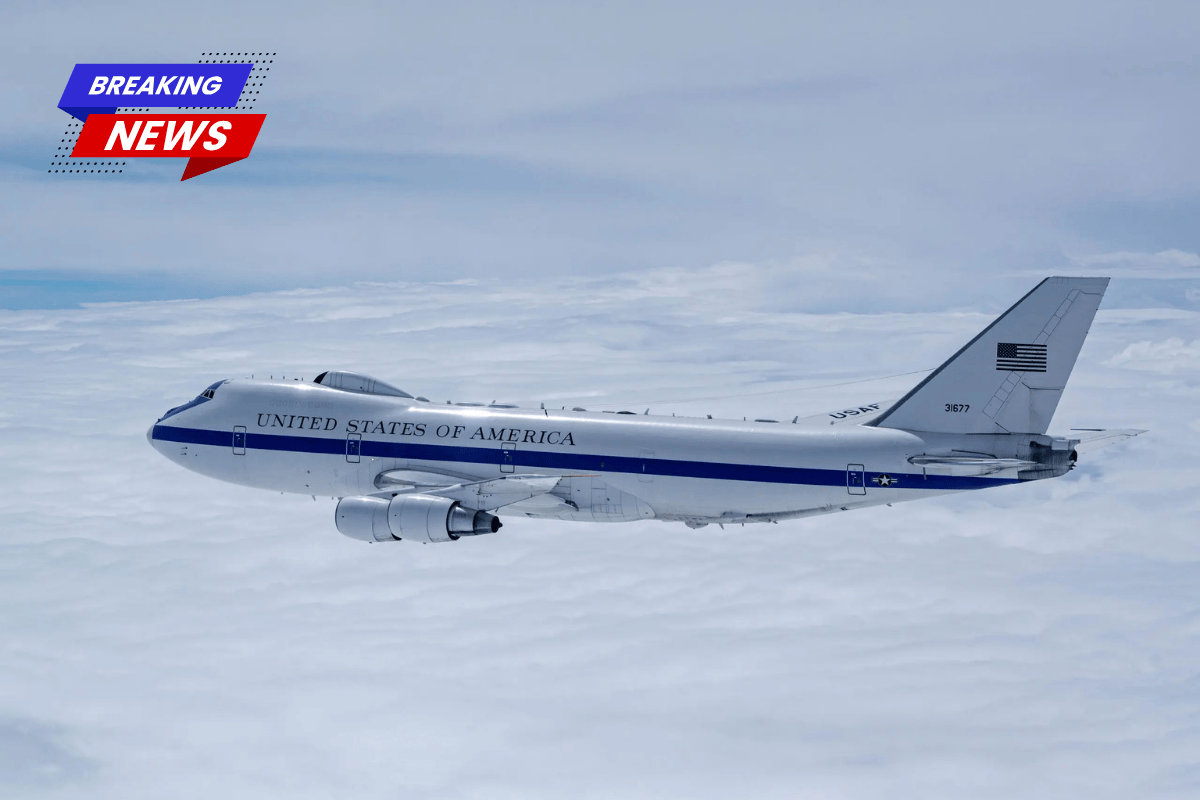
President Donald Trump’s emergency command aircraft, the Boeing E-4B Nightwatch, also known as the “Doomsday plane,” has been spotted making several loops over Offutt Air Force Base in Nebraska. The aircraft’s flight is raising eyebrows as tensions in the Middle East escalate, and the U.S. prepares for potential military actions in response to Iran’s rejection of a ceasefire proposal.
The E-4B and Its Role in National Security
The Boeing E-4B Nightwatch serves as a flying command post for key U.S. officials, including the president, vice president, and Secretary of War, during crises. This heavily modified Boeing 747 is designed to withstand nuclear blasts, electromagnetic pulses (EMPs), and other catastrophic scenarios, making it an essential part of the U.S. military’s contingency plans.
Typically, the aircraft is used for training exercises to ensure that pilots and mission crews remain proficient in critical skills such as instrument approaches, touch-and-go landings, low-level maneuvers, and holding patterns. These exercises ensure that the E-4B can be quickly launched if needed during an emergency.
Flight Details and Routine Training
On Monday, the E-4B left Offutt Air Force Base at 10:17 AM ET and conducted at least six loops above the base before soaring off toward Strahan, about 40 miles east. The flight is consistent with routine exercises designed to keep the aircraft and its crew in a state of readiness.
The airspace south and southeast of Offutt is preferred for these exercises due to its low civilian air traffic, allowing military flights to conduct repeated circuits without disrupting commercial aviation.
The Nightwatch’s maneuvers included low approaches to Offutt’s runways followed by immediate takeoffs, a technique known as a touch-and-go. These types of exercises help ensure that pilots are prepared to respond quickly in the event of a crisis.
Connection to Middle East Tensions
While the flight is part of standard training, it coincides with rising tensions in the Middle East. Iran recently rejected a ceasefire proposal put forward by Pakistan, known as the Islamabad Accord, which aimed to broker a permanent end to the ongoing war. The proposal included a ceasefire, followed by negotiations to resolve the conflict permanently.
In response, President Trump issued a stark warning to Iran, threatening to unleash “hell” on Tehran unless the country agreed to a deal by Tuesday that would reopen the vital Strait of Hormuz, a critical waterway for global energy supplies.
Escalating War and Strategic Significance
The E-4B’s flight on Monday also came amid Israeli airstrikes on Iranian petrochemical sites, marking the third such attack in just a few days. These developments suggest that tensions are reaching a boiling point, with Iran rejecting attempts at peace and continuing to escalate military actions.
While the E-4B’s flight is officially being described by the U.S. Air Force as part of routine training operations, the timing of the aircraft’s deployment, alongside Trump’s warnings and Iran’s defiant stance, has led some observers to speculate about a connection to the growing crisis.
Public Reaction and Online Speculation
The flight of the Doomsday plane prompted speculation on social media, with users linking its presence to fears of escalating conflict. Some users questioned whether the plane’s deployment signaled an impending military action or if it was merely a precautionary exercise.
One user commented, “The Presidential ‘Doomsday Plane’ is airborne, so either something very serious is happening, or Patel is on another date.” Another user pointed out, “The plane’s deployment, which can withstand nuclear-level attacks, is probably not a good sign.”
However, the Pentagon has clarified that the Nightwatch’s flight is a standard training sortie, and that similar exercises have been conducted for years. The last published flight of an E-4B occurred in January when the aircraft was spotted in Los Angeles as part of a nationwide campaign to highlight U.S. defense production and military recruitment efforts.
Routine Exercise or Sign of Escalation?
Despite the official explanation from the Pentagon, the coincidence of the Nightwatch flight with rising tensions in the Middle East has fueled speculation about the broader implications of the aircraft’s deployment.
While the flight may indeed be part of a routine exercise, the heightened geopolitical situation, combined with Trump’s threats to Iran, adds an element of uncertainty to the military activity.
As the war in the Middle East stretches into its second month, the Doomsday plane‘s presence in the skies serves as a reminder of the U.S. government’s preparedness for any eventuality, even as the world watches for signs of further escalation.