
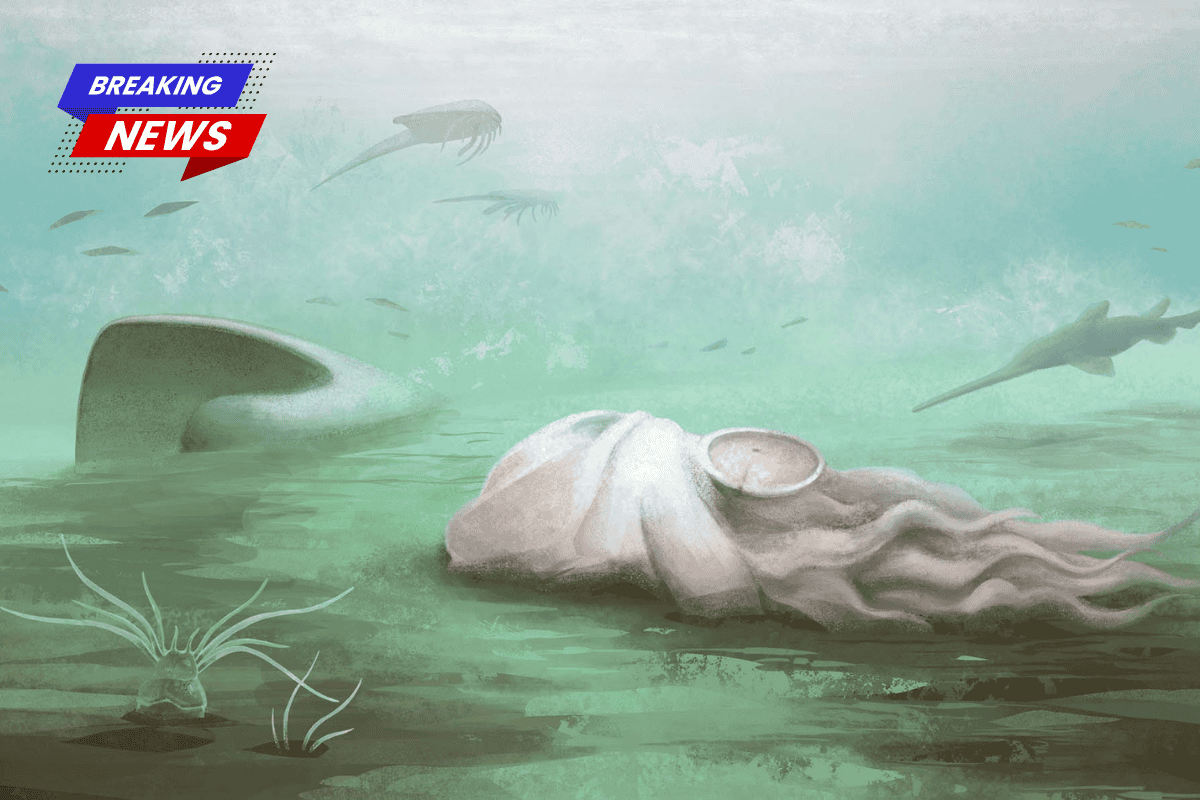
A fossil once believed to be the world’s oldest octopus has now been reclassified after new research revealed it actually belongs to a different type of sea creature. Scientists have found that the fossil is not an early octopus, but instead comes from a nautiloid, a relative of the modern nautilus that has tentacles and an external shell. The findings were published in the journal Proceedings of the Royal Society B.
What Scientists Discovered
The fossil, named Pohlsepia mazonensis, was originally thought to be an ancient octopus because of its shape. However, researchers used advanced modern techniques to study it more closely and found hidden features inside the rock that told a different story. According to Thomas Clements, the team used several new tools to uncover details that were not visible before, helping them correctly identify the fossil as a decomposed nautiloid.
Where the Fossil Was Found
The fossil was discovered at the Mazon Creek site near Chicago in the United States. This location is famous for preserving ancient marine life. Scientists had long been confused by this fossil because it appeared to be around 300 million years old, much older than any known octopus fossil, which dates back only about 90 million years.
Why the Confusion Happened
The animal had already started decomposing before it was buried, which changed its appearance. This made it look like an octopus, especially its arm-like structures. However, some experts had doubts because certain features did not match what is typically seen in octopuses, such as the shape and length of the arms.
How the Truth Was Found
Researchers reexamined the fossil using modern tools like electron microscopes and chemical analysis, but the real breakthrough came with synchrotron imaging. This powerful technique uses extremely bright light to create detailed X-ray images. It allowed scientists to see structures hidden beneath the surface of the rock.
One key discovery was a radula, a feeding organ with rows of tiny teeth. The fossil had at least 11 teeth per row, while octopuses usually have only seven or nine. This difference confirmed that the fossil was not an octopus.
Why This Matters
This discovery shows how new technology is changing the way scientists study ancient life. Tools like synchrotron imaging are helping researchers uncover details that were impossible to see before. According to Clements, paleontology is no longer just about studying old bones and rocks but is now a highly advanced and innovative field.






