
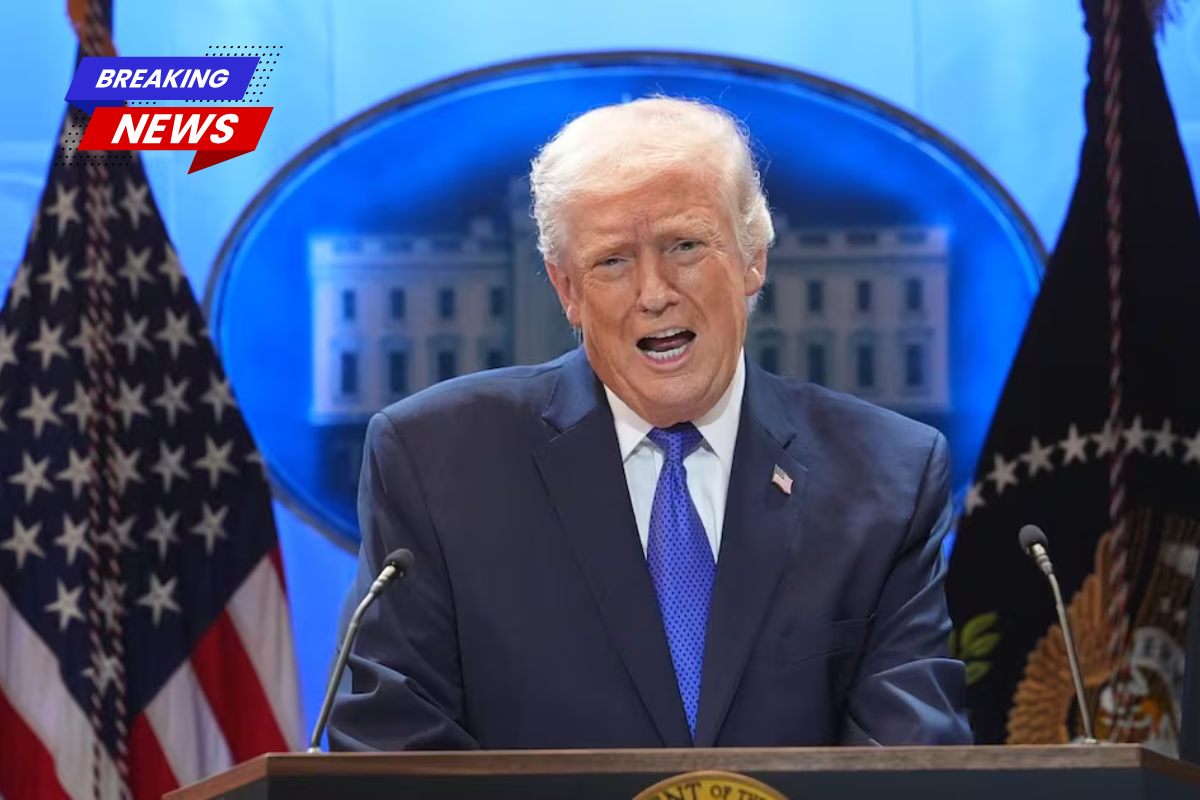
In the past 24 hours, the Trump administration’s stance on the ongoing conflict with Iran has been marked by rapid shifts, ranging from claims of a ceasefire holding and military operations concluding, to renewed threats of bombing if Iran does not agree to U.S. terms.
This evolving narrative has left many questioning the administration’s strategy and whether the U.S. can successfully resolve tensions over the Strait of Hormuz, a vital waterway for global oil shipments.
Conflicting Messages on the Status of Military Operations
The day began with Defense Secretary Pete Hegseth explaining how U.S. forces were protecting stranded commercial ships attempting to navigate the Strait of Hormuz.
He insisted that the operation was defensive, maintaining that the ceasefire with Iran was still in effect despite Iranian missile and drone attacks on U.S. forces. Hegseth also noted that the U.S. had successfully sunk several Iranian small attack boats in retaliation.
By the afternoon, Secretary of State Marco Rubio announced that the U.S. military operation was “concluded,” claiming that the U.S. had achieved its objectives. But he quickly added that President Donald Trump was still pursuing a “path of peace” and hoped for a diplomatic solution that would lead to the reopening of the Strait.
However, just hours later, Trump took to Truth Social, announcing that the military operation to protect ships was temporarily halted while negotiations continued. By the following morning, Trump was once again warning that bombing would resume if Iran failed to agree to U.S. terms. “If they don’t agree, the bombing starts, and it will be, sadly, at a much higher level and intensity than it was before,” he wrote.
A Rollercoaster of Decision-Making and Messaging
This erratic decision-making and often contradictory messaging from the Trump administration has raised concerns about the overall coherence of the U.S. strategy in the region.
Despite the administration’s efforts to maintain a ceasefire, the uncertainty surrounding the future of the Strait of Hormuz and the growing economic fallout from rising fuel prices are complicating matters for Republicans, who face increasing pressure ahead of the midterm elections.
Elizabeth Dent, a senior fellow at the Washington Institute for Near East Policy, argued that the administration’s confusion is rooted in the fact that the conflict was not well planned from the outset. “Because it happened very quickly, it wasn’t sold to the American public in a way that I think was palatable,” she said. Dent suggested that Trump is now working to avoid further hostilities, having witnessed the unpopularity of the war.
Trump’s tendency to make off-the-cuff statements has added to the difficulty of shaping a consistent policy. After each comment, aides like Rubio and Hegseth have had to step in to clarify the administration’s position, often leading to conflicting messages.
The Administration’s Struggle with International Support
Complicating matters further, the Trump administration has found itself seeking assistance from international allies to help secure the Strait of Hormuz. Saudi Arabia, a key U.S. ally, expressed skepticism about Trump’s plan to guide the stranded vessels through the strait, questioning whether it was a feasible solution to the crisis.
The Saudi government reportedly voiced concerns over the plan’s ability to restore confidence in the waterway for commercial vessel operators and insurers. While Britain and France have declined to participate directly in U.S. military efforts, they have taken the lead in forming a separate international coalition aimed at securing the strait, but only once the immediate threat to shipping has been neutralized.
Trump’s Strategy Faces Criticism and Scrutiny
Despite these efforts to rally international support, the U.S. strategy is increasingly viewed as disconnected from the reality of the situation. Ali Vaez, the Iran director at the International Crisis Group, suggested that Trump’s approach is reactive, driven by impulse rather than a clear, coherent policy. “This is not an administration that operates based on a policy process.
It operates based on impulse,” he said. Vaez noted that Trump seemed both tired of the war and reluctant to continue investing political capital in a conflict that has become increasingly unpopular.
The situation is further complicated by the president’s upcoming trip to Beijing next week, where he will likely have to ask China for help in resolving the crisis, a scenario that many experts see as weakening Trump’s position. “Going to China while the strait remains closed is humiliating for President Trump and puts China in a position of strength,” Vaez added.
The Road Ahead for U.S.-Iran Relations
As the situation in the Strait of Hormuz continues to evolve, the Trump administration faces growing pressure to clarify its strategy and resolve the conflict. The uncertainty surrounding the U.S. approach has created confusion, both domestically and internationally, as the Trump administration continues to walk a fine line between military action and diplomatic efforts.
For now, the focus remains on the possibility of a negotiated agreement to reopen the vital shipping route and bring an end to the ongoing tensions. Whether the Trump administration can achieve a lasting solution remains to be seen, but the fluctuating messaging and shifting strategies over the past week indicate that the path forward may not be as clear as it once seemed.






