
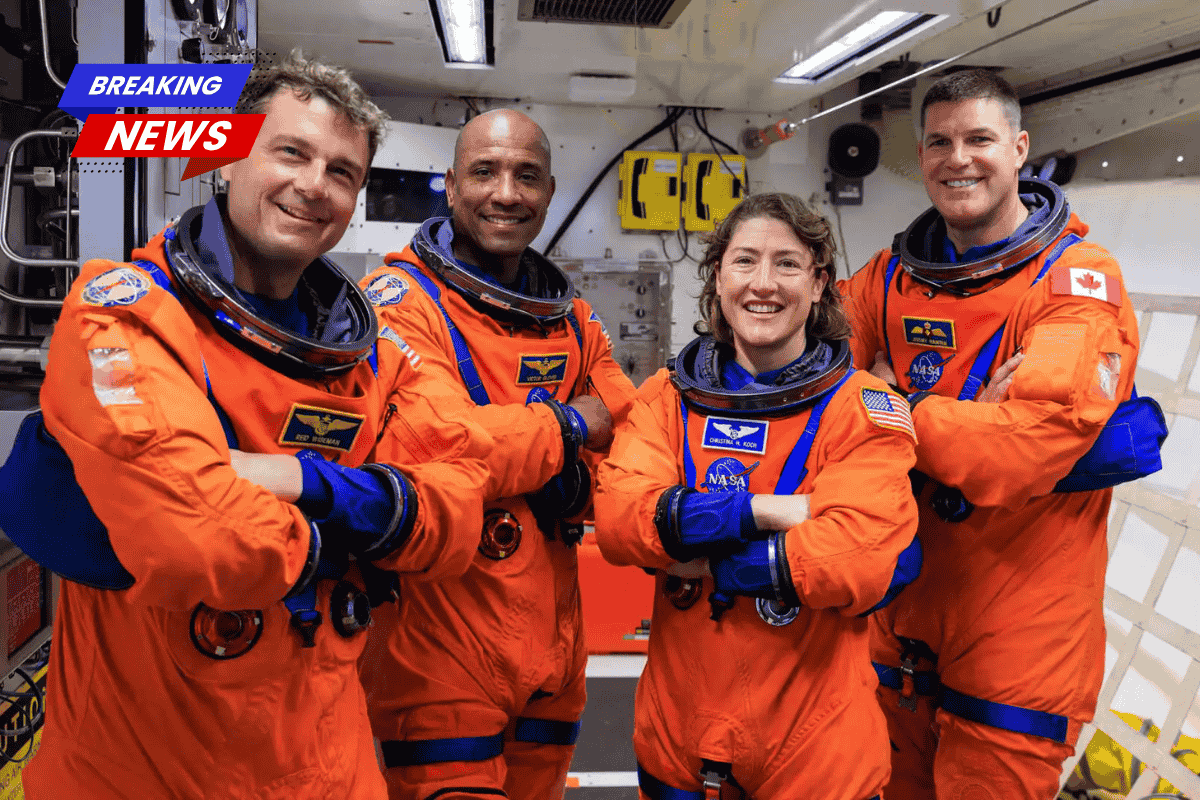
The astronauts of NASA’s Artemis II mission made history yesterday by looping around the far side of the moon and venturing farther into space than any humans before them. However, despite the historic achievement, the compensation for these astronauts is not as extraordinary as one might expect.
Astronauts Return to Government Salaries After Historic Mission
After their groundbreaking journey, the crew—U.S. astronauts Reid Wiseman, Victor Glover, and Christina Koch, alongside Canadian astronaut Jeremy Hansen—will return to their government salaries. U.S. crew members top out at around $152,000, while Canadian pay follows a similar scale.
For a mission that pushed the limits of human exploration, this pay is strikingly modest. The compensation is more in line with mid-career office jobs or skilled trades, such as electricians or HVAC technicians, than it is with a once-in-a-lifetime journey around the moon.
Like other federal employees on business trips, these astronauts had their transportation, lodging, and meals provided. They also receive a small daily stipend of about $5 for incidentals, according to a NASA spokesperson.
Why Astronauts Take the Pay Cut
The disparity between the historic nature of the mission and the relatively modest compensation reflects the dedication required for space exploration. Thousands of people are willing to make this tradeoff for a chance at becoming an astronaut.
NASA’s 2025 astronaut class, for instance, selected just 10 candidates from more than 8,000 applicants—an acceptance rate of about 0.125%, even more exclusive than Ivy League universities like Harvard and Stanford.
The Future of Work in Space: Elon Musk and Sam Altman’s Vision
While the astronauts are back to their government jobs, some of the world’s most influential business leaders are betting that space could soon become a new frontier for work. Elon Musk and Sam Altman, CEOs of SpaceX and OpenAI, respectively, see the future of work in space.
Google CEO Sundar Pichai has suggested that the company could begin testing hardware in orbit by 2027, aiming to build data centers in space to handle the growing computing demands. “There’s no doubt to me that a decade or so away we’ll be viewing it as a more normal way to build data centers,” Pichai said.
Musk, whose company SpaceX is at the forefront of space exploration, has even bolder plans. He hopes to establish a self-sustaining city on the moon within the next decade, a timeline he believes is more feasible than establishing a colony on Mars. “The mission of SpaceX remains the same: Extend consciousness and life as we know it to the stars,” Musk wrote on X.
Sam Altman’s Vision for Gen Alpha’s Future in Space
Sam Altman, CEO of OpenAI, predicts that the rapidly advancing field of space exploration could lead to a shift in the workforce. “In 2035, that graduating college student, if they still go to college at all, could very well be leaving on a mission to explore the solar system on a spaceship in some completely new, exciting, super well-paid, super interesting job,” Altman said in an interview last year.
The Path to a Space-Based Workforce
Despite these ambitious plans, the road to a space-based workforce remains uncertain. NASA is targeting next year to launch Artemis III, a test of lunar landers, followed by Artemis IV in 2028, which aims to return astronauts to the moon’s surface.
However, NASA projects an average launch delay of about 12 months for major projects, according to the U.S. Government Accountability Office.
The Current Space Industry on Earth
For those looking to enter the space industry today, the clearest path remains on Earth. Aerospace engineers, for instance, earn an average of $135,000, according to the U.S. Bureau of Labor Statistics, with the field expected to grow by 6% over the next decade.






