
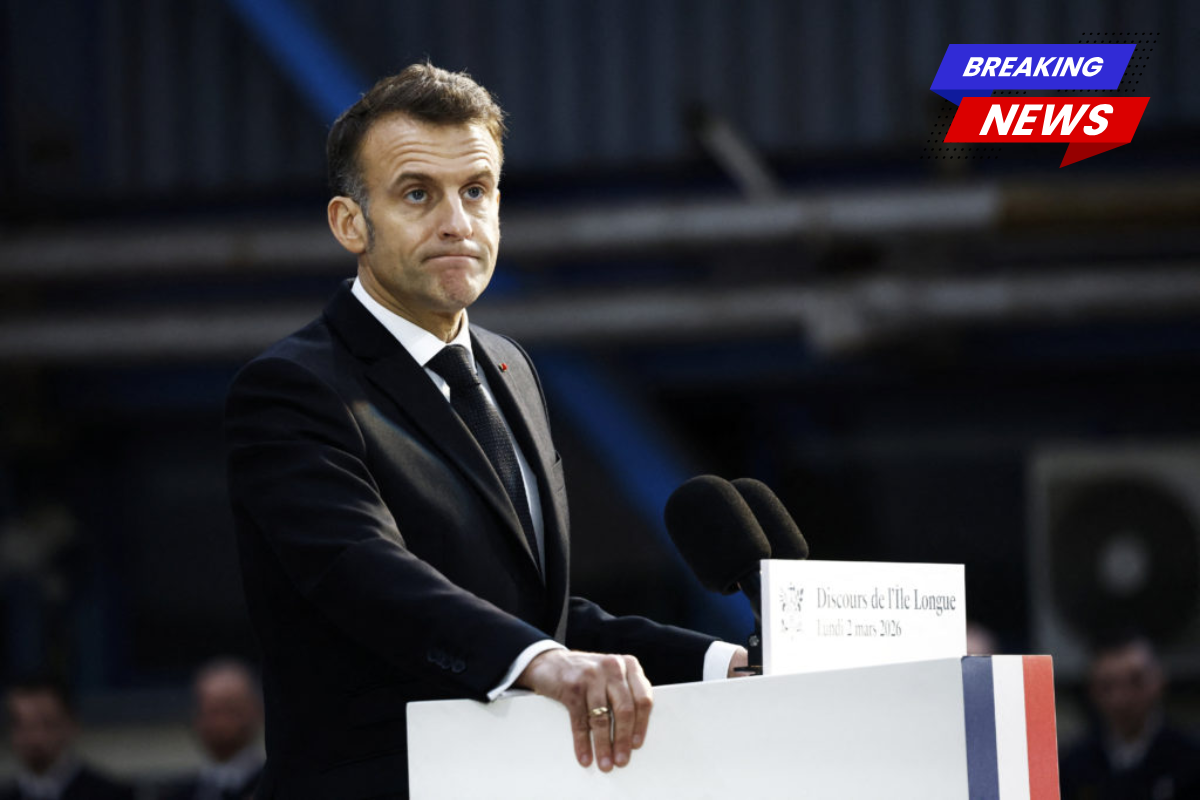
French President Emmanuel Macron has announced a major shift in France’s nuclear strategy, saying the country will allow the temporary deployment of its nuclear-armed aircraft to allied nations. The move comes at a time when European leaders are questioning long-term security guarantees and looking for stronger regional defence cooperation.
France to Deploy Nuclear-Armed Aircraft to Allies
Speaking at a military base in L’Ile Longue in northwestern France, President Emmanuel Macron said France would allow elements of its strategic air forces to be temporarily stationed in allied countries.
However, he made it clear that while aircraft may be deployed abroad, control over nuclear weapons will remain entirely with France. There will be no sharing of decision-making authority with any other country regarding the use of nuclear arms.
Talks about these arrangements have already started with several European nations, including:
- Britain
- Germany
- Poland
- The Netherlands
- Belgium
- Greece
- Sweden
- Denmark
Increase in Nuclear Warheads Announced
Macron also revealed that France will increase the number of nuclear warheads in its arsenal. Currently, France maintains fewer than 300 warheads. This marks the first announced increase in the country’s nuclear stockpile since at least 1992.
Although Macron did not specify the exact number of additional warheads, he said the decision was necessary to maintain France’s nuclear deterrence power.
He stated that his responsibility is to ensure that France’s nuclear deterrent continues to provide assured destructive capability in the future.
Europe’s Security Concerns and Nuclear Umbrella Debate
Macron’s announcement comes amid growing concerns in Europe about long-term security commitments from the United States. Some European leaders have expressed uncertainty about the reliability of the U.S. nuclear umbrella, which has long served as a key part of NATO’s defence strategy.
The nuclear umbrella refers to the protection the U.S. offers its allies by promising nuclear defence if they are threatened.
France is currently the only nuclear power within the European Union. The United Kingdom, although no longer part of the EU, also maintains its own nuclear deterrent as a NATO member.
Earlier this month, German Chancellor Friedrich Merz confirmed that he had initial discussions with Macron about nuclear cooperation. He even suggested the possibility of German Air Force planes carrying French nuclear bombs in the future.
France and UK Nuclear Coordination
In July, France and Britain signed a joint declaration allowing their nuclear forces to be coordinated, although they remain fully independent.
Despite closer cooperation, Macron has consistently stressed that the final decision to use France’s nuclear weapons will always remain with the French president alone.
He also warned that if France ever had to use its nuclear arsenal, no nation — regardless of size or power — would be able to escape its impact.
A Strategic Shift for Europe
Macron’s speech signals a broader effort to strengthen Europe’s independent defence capabilities. By allowing temporary deployment of nuclear-capable aircraft to allied nations, France aims to reassure partners and reinforce deterrence within the region.
The move reflects Europe’s desire to build stronger internal security structures while still working within NATO frameworks.






