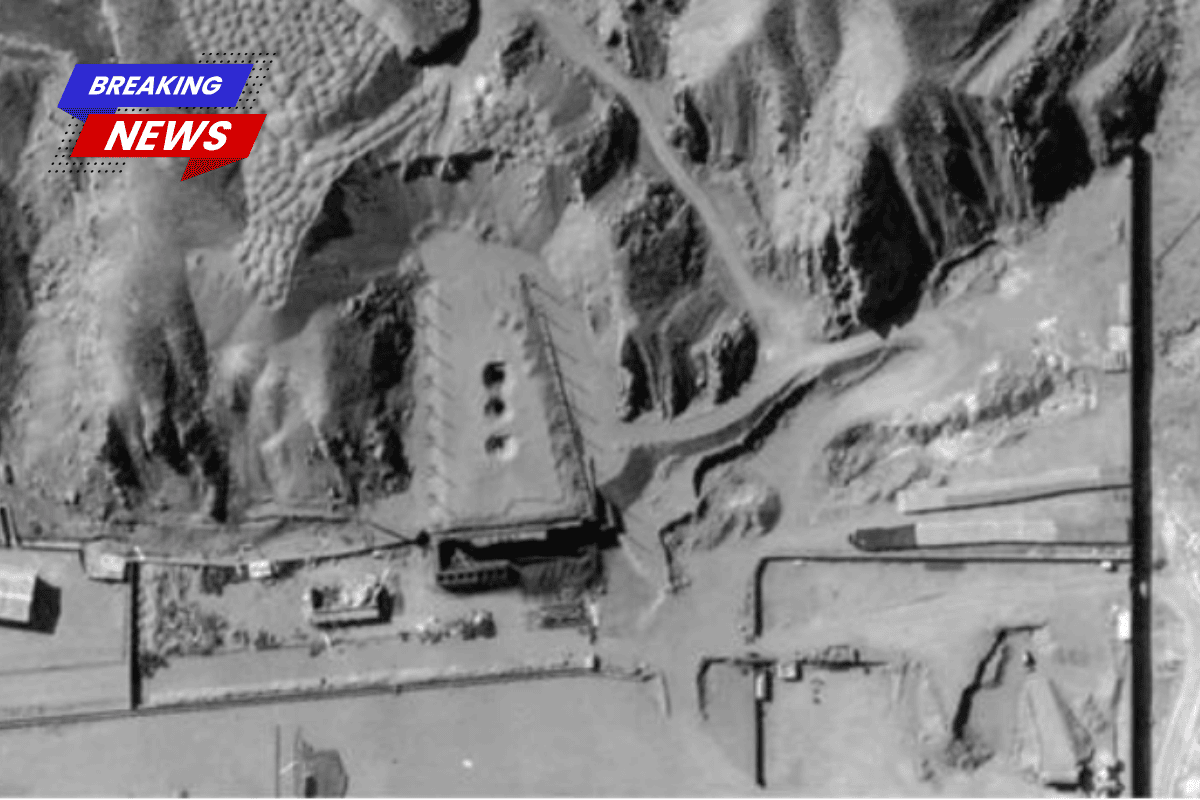
New satellite images have revealed significant damage at Iran’s Taleghan 2 facility, a site long suspected of being connected to the country’s nuclear research. The images show several large impact points that analysts believe may have been caused by extremely powerful bunker-busting bombs designed to destroy deeply buried structures.
While the exact weapons used have not been officially confirmed, the strike appears to be part of a broader effort to target infrastructure linked to Iran’s nuclear capabilities.
Satellite images reveal damage at Taleghan 2
Satellite imagery released by Vantor on March 11 shows three large and precise impact craters at the Taleghan 2 site, located within the Parchin military complex in Iran. The size and pattern of the damage suggest the strike involved extremely powerful munitions capable of penetrating reinforced underground structures.
Taleghan 2 has been associated for years with allegations of nuclear-related research, particularly work involving high-explosive testing that could be used in nuclear weapons development. Iran has repeatedly denied these claims, maintaining that its nuclear program is strictly for peaceful purposes.
The images show that the impacts were concentrated directly on the hardened portion of the facility, indicating the strike was carefully targeted.
Possible use of massive bunker-buster bombs
Military analysts studying the satellite images believe the craters could have been caused by the GBU-57/B Massive Ordnance Penetrator, one of the most powerful conventional bunker-buster bombs in the world.
The GBU-57/B weighs about 30,000 pounds and is specifically designed to destroy deeply buried or heavily reinforced underground facilities. It is typically carried by the U.S. Air Force’s B-2 stealth bomber, which can deploy two of these bombs during a single mission.
Analysts note that the damage pattern at Taleghan 2 resembles the craters seen at other Iranian nuclear facilities struck during earlier operations. In particular, similar bombs were reportedly used during Operation Midnight Hammer, when U.S. forces targeted sites such as Fordow and Natanz.
During that operation, multiple GBU-57 bombs were dropped in order to penetrate deep underground chambers and collapse hardened structures.
Reinforcement of the facility before the strike
Satellite images from recent months show that Iran had strengthened the Taleghan 2 site before the latest attacks.
Images taken in November 2025 and again on March 6, 2026 indicate that the facility had been encased in a thick concrete shell. Additional layers of soil were later placed over the structure, likely to increase protection against air strikes.
These preparations suggest Iranian engineers expected the site could become a target.
Analysts say the heavy reinforcement would require extremely powerful weapons to ensure destruction. Standard bunker-buster bombs might struggle to penetrate deep enough to reach underground chambers protected by reinforced concrete and thick earth layers.
This could explain why analysts believe heavier munitions were used.
Alternative possibilities for the type of weapons used
Although the GBU-57 bomb is a strong possibility, analysts caution that the exact weapons used cannot be confirmed from satellite images alone.
There are several other possibilities:
- Multiple 2,000-pound bunker-buster bombs dropped in sequence
- Precision-guided bombs aimed at weak points in the structure
- Repeated strikes designed to gradually penetrate the facility
Military planners often combine these approaches depending on the depth and structure of the target.
In previous operations in the Middle East, U.S. Central Command has used successive strikes with smaller bunker-busters to achieve similar results as heavier bombs.
Comparison with earlier strikes on Iranian nuclear facilities
The damage at Taleghan 2 has drawn comparisons with previous attacks on Iranian nuclear infrastructure.
In earlier operations:
- Fordow nuclear facility was targeted with multiple heavy bunker-busters
- Natanz nuclear facility was struck using a combination of precision munitions
- Several sites within the Parchin military complex were attacked during previous conflicts
Those earlier strikes demonstrated how difficult it is to destroy deeply buried nuclear facilities.
In some cases, attackers targeted air shafts or ventilation openings to allow bombs to penetrate deeper into underground chambers. Analysts note that Taleghan 2 does not appear to have visible ventilation shafts, which may have required heavier bombs to achieve the same effect.
Strategic importance of Taleghan 2
Taleghan 2 is considered a significant target because of its suspected connection to Iran’s historical nuclear weapons research.
Western intelligence agencies have long alleged that the Parchin complex was used to develop specialized high explosives that could trigger a nuclear weapon. Iran has consistently rejected these accusations and insists its nuclear program is for civilian purposes such as energy production and medical research.
Israel previously targeted the Taleghan 2 area in 2024, and parts of the Parchin complex were also struck during a regional conflict often referred to as the 12-Day War.
After those attacks, Iran reportedly rebuilt sections of the facility.
What happens next
It is still unclear how much damage the latest strike caused. Satellite imagery can reveal surface damage, but it often takes weeks or months to determine whether underground structures were fully destroyed.
Military analysts and intelligence agencies will continue studying new satellite images in the coming weeks to look for signs such as:
- Collapsed underground tunnels
- Continued smoke or heat signatures
- Reconstruction activity at the site
If Iran begins rebuilding again, it could indicate that key parts of the facility survived the strike.