In a bold move aimed at reshaping the U.S. pharmaceutical industry, President Donald Trump has ordered a 100% tariff on brand-name drugs produced overseas, escalating his administration’s efforts to encourage drug companies to manufacture more products within the United States.
Details of the Tariff and Its Impact
The new tariff order, signed on April 2, 2026, seeks to reduce the United States’ reliance on foreign-produced medications, particularly in the wake of potential global supply chain disruptions. According to the order, the 100% tariff will apply to brand-name drugs still under patent. However, drug companies that commit to moving production to the U.S. will face a 20% tariff during their transition period.
If they also agree to lower prices to “most favored nation” levels (the lowest prices paid by other countries), they will avoid the tariff entirely. The full 100% tariff will be levied if drug production remains outside the U.S. after four years.
While the tariff takes effect on July 31, 2026, for some companies and September 29, 2026, for others (depending on their size), countries like the European Union, Japan, South Korea, Switzerland, and the United Kingdom are exempt due to existing trade agreements with the United States.
Motivation Behind the Tariff
The White House believes this action will make the U.S. less reliant on other nations for critical medications. The order highlighted that approximately 53% of patented drugs distributed in the U.S. are currently manufactured abroad, which poses a risk if geopolitical or economic disruptions occur.
A senior White House official stated, “The United States is heavily reliant on imports, threatening access to life-saving medications during global supply chain disruptions.”
However, experts have raised concerns that the tariff could lead to higher drug prices, especially for those dependent on foreign-made medications.
Trump’s Push for Domestic Drug Production
Trump has long pushed for U.S. pharmaceutical companies to bring production back to American soil. This new tariff is the latest in a series of actions aimed at achieving that goal.
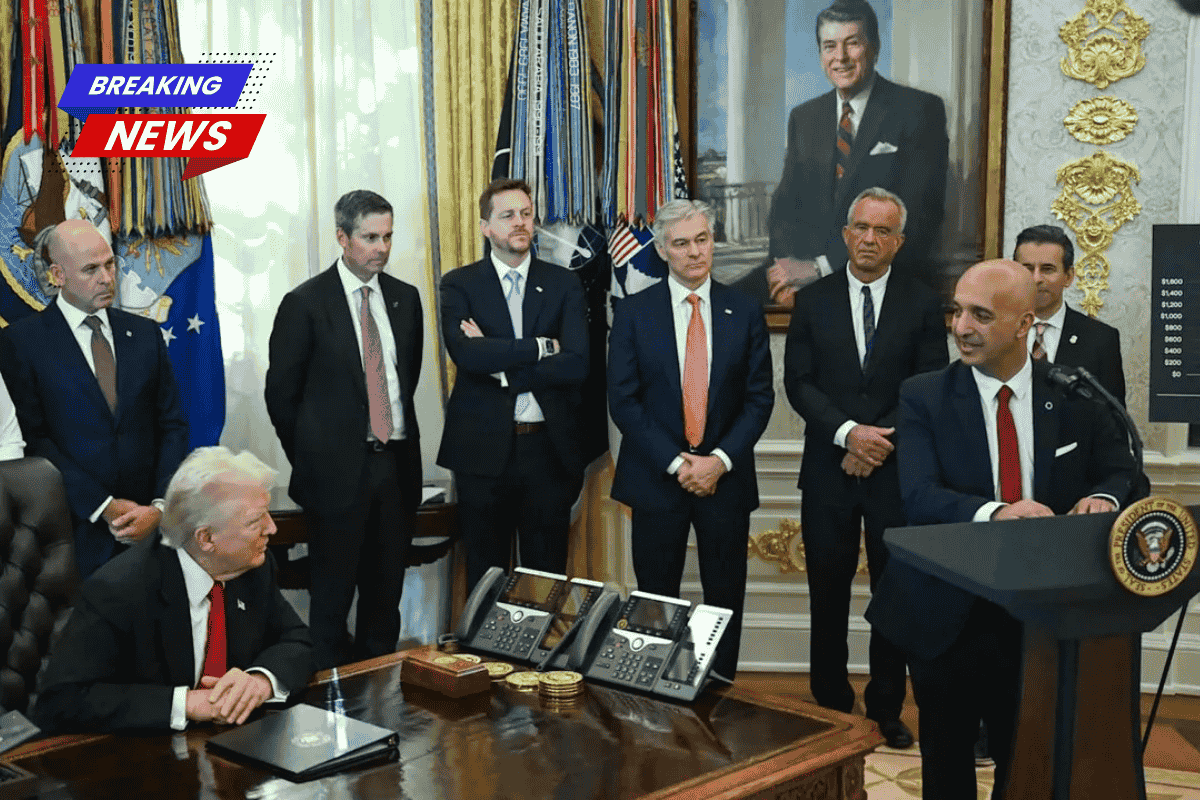
In December 2025, the president held a White House event announcing that nine major pharmaceutical companies, including Amgen, Boehringer Ingelheim, Merck, and Novartis, had agreed to cut prices on their drugs. The administration also introduced the TrumpRx website in February 2026, designed to help Americans access lower-priced medicines.
According to White House officials, drug companies have also pledged to invest hundreds of billions of dollars in U.S. manufacturing.
Criticism and Political Pushback
The tariff move has faced criticism from both Democrats and some Republicans, who argue that such aggressive trade policies could lead to higher prices for consumers.
The Democratic National Committee (DNC) accused Trump of damaging the economy with what it described as a “reckless trade war.” Despite this, the Trump administration has remained steadfast in its support of the tariffs, with White House spokesman Kush Desai declaring that the president’s trade policies are “making our country wealthy, strong, and respected once again.” Desai further stated, “This is just the beginning of the President’s transformation of global trade.”
Expansion of Tariffs on Foreign Metals
Along with the pharmaceutical tariffs, Trump also revised tariffs on foreign steel, aluminum, and copper. These changes aim to prevent foreign steel exporters from circumventing tariffs by undervaluing the metal they export to the U.S.
The revision also alters the tariff structure for finished products containing less than 15% metal, eliminating it for some products while adjusting the calculation for others with more metal content.
The Larger Picture of Trade and Tariffs
The pharmaceutical tariff is part of Trump’s broader efforts to reshape global trade dynamics. The White House sees the new policy as a step toward securing the U.S. economy and reducing dependence on other countries for essential products.
However, the policy remains controversial, and its long-term impact on both the pharmaceutical industry and U.S. consumers remains to be seen.