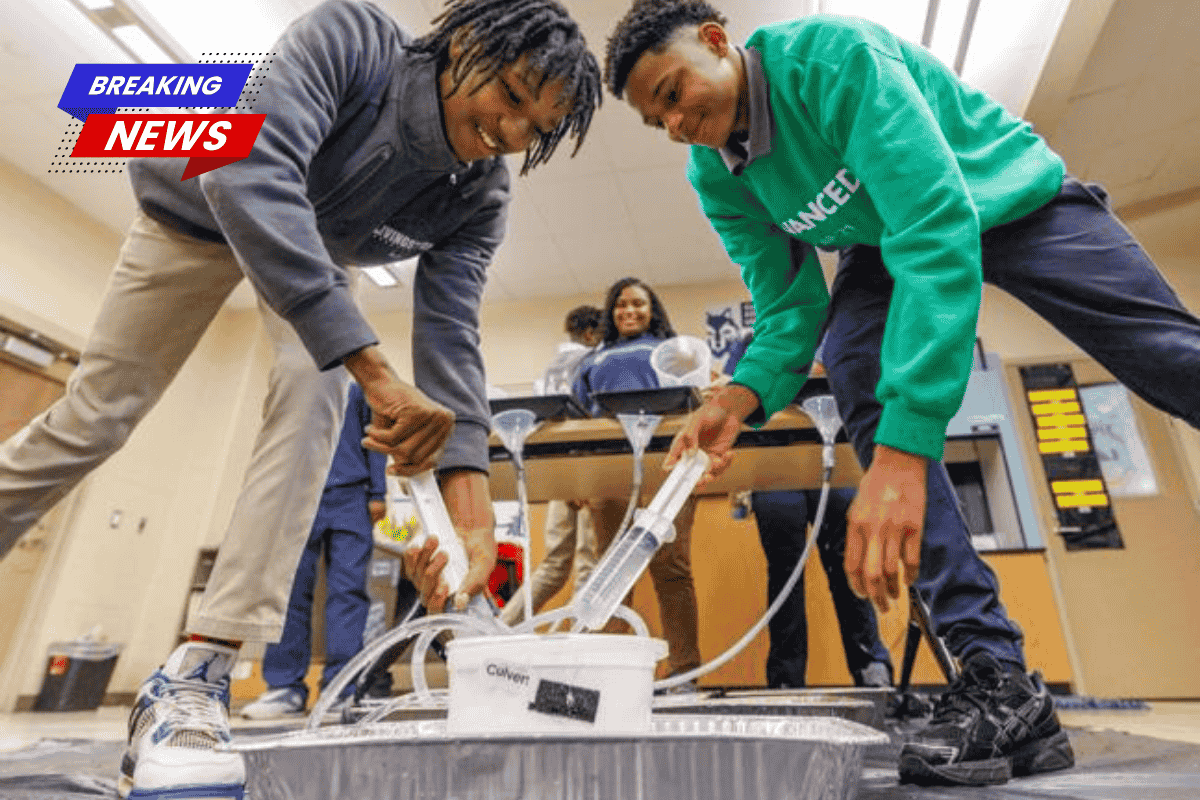
A recent class at Livingston Collegiate Academy in New Orleans East gave ninth-grade students a hands-on experience in understanding the complexities of New Orleans’ flood control system.
The class, part of an environmental science curriculum designed by the Ripple Effect nonprofit, uses interactive lessons to teach students about levees, pumps, coastal erosion, and the challenges of subsidence.
The Lesson in Action: A Hands-On Experiment
During a recent class, Deandria Barnes, a science teacher at the school, used a plastic tub rigged with tubing to model New Orleans’ drainage system. Students used syringes to simulate the pumps that keep the city from flooding.
The lesson started with light drizzle and quickly escalated into heavy rain, which overwhelmed the system. The students observed how pump failures and water overflow can lead to flooding—a vivid illustration of the city’s struggles with drainage.
Environmental Science for Local Students
The Ripple Effect program, created by Claire Anderson, is designed to bring real-world science into New Orleans classrooms, focusing on issues like flooding, subsidence, coastal erosion, and the dead zone in the Gulf of Mexico.
Anderson, who started the program in 2013, aims to expand the curriculum across more high schools in Louisiana, where hands-on labs and physical models engage students in environmental science and local issues.
The curriculum covers critical environmental topics, helping students understand the complexities of the region’s infrastructure and ecological challenges. Through interactive activities and classroom discussions, students are introduced to concepts they may never have encountered before, especially in a city like New Orleans, where flooding and climate change are constant concerns.
The Ripple Effect on Students
For many students like Cornell Jackson and Daniyah Smart, the program has shed new light on their personal experiences with flooding. Jackson, whose home recently flooded during a rainstorm, gained a deeper understanding of why such floods happen. Smart, who had never noticed storm drains before, now pays closer attention to them, realizing how blocked drains can contribute to flooding.
“This could really cause flooding,” Smart said, showing an awareness of the system that she hadn’t grasped before.
Understanding the System’s Contradictions
While the students had fun with the interactive models, they also learned about the flaws in the city’s flood control systems. For example, levees protect the city from floodwaters but also trap sediment, preventing the natural land-building process and contributing to coastal erosion. The pumps that prevent neighborhood flooding often become overworked and break down, leading to further complications.
As the class discussed these issues, they began to question the efficiency and cost of the system. One student pointed out that, despite the city spending $14.6 billion to upgrade the flood control system, the existing pumps still frequently break down. “We need bigger pumps,” another student responded, highlighting the need for an improved system.
Overcoming Funding Challenges
While the program is widely praised, Ripple Effect has faced significant funding cuts in recent years, with a loss of $1.9 million in federal grants due to budget cuts under the Trump administration.
Despite this, Anderson remains optimistic, stating, “The loss of funding will not sink our organization.” She emphasized that while they can no longer rely on government funding, the program will continue to survive, thanks to its dedicated board and financial reserves.
One of Anderson’s goals is to expand the program to include field trips, allowing students to experience real-world environmental research and see firsthand how scientists study the region’s ecosystem.