
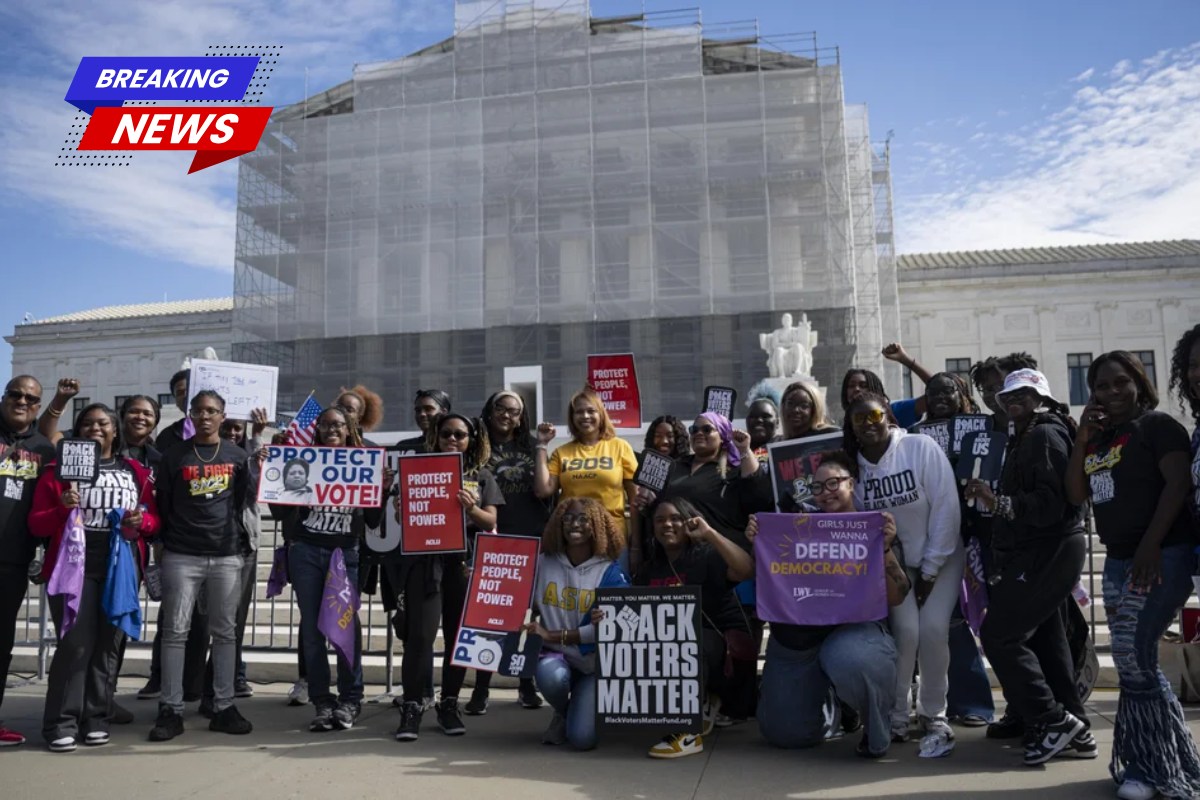
The U.S. Supreme Court has ruled to allow Alabama to use a newly drawn House district map for the upcoming 2026 midterm elections, despite ongoing legal challenges. The decision, which was made on Monday, clears the way for Alabama to implement the map that had been blocked by lower courts, specifically a GOP-drawn map from 2023 that includes only one majority-Black district.
Supreme Court Clears Alabama’s New House Map for 2026 Elections
In a divided ruling, the Supreme Court set aside previous decisions from lower courts that had blocked the state’s 2023 House map, which contained one majority-Black district out of seven. The high court’s ruling came after an earlier decision in 2026, which weakened the Voting Rights Act and had implications for redistricting decisions across the country.
The ruling appears to be a 6-3 decision, with Justices Sonia Sotomayor, Elena Kagan, and Ketanji Brown Jackson dissenting. Justice Sotomayor, joined by her liberal colleagues, argued in her dissent that the Supreme Court’s decision to overturn the district court’s rulings would cause confusion for Alabama voters as the state prepares for elections scheduled in just a few weeks.
The controversy over Alabama’s House districts stems from the 2021 decision in which the Supreme Court agreed with a lower court that Alabama’s congressional map violated Section 2 of the Voting Rights Act, as it diluted the voting power of Black residents.
In response to that ruling, the state’s lawmakers redrew the district lines in 2023, but the new map continued to feature only one majority-Black district, which sparked further legal challenges.
The 2024 and 2026 Maps: Key Differences
The map used in the 2024 elections, which was selected by a three-judge panel, includes two majority-Black districts, whereas the 2023 version proposed by Alabama’s Republican-controlled legislature retains only one.
Alabama’s officials argued that the new map adhered to traditional redistricting principles, minimizing county splits and respecting the boundaries of regions like the Black Belt, a rural area known for its fertile soil and historical Black population.
However, the state’s critics, including Democratic Rep. Shomari Figures, have voiced concerns about the impact of the new map. Figures, who represents one of Alabama’s predominantly Black districts, called the Supreme Court’s decision “incredibly unfortunate” and warned that it could set back Black political representation in Alabama.
He expressed hope that the decision would be only a “temporary setback” and that the lower courts would eventually preserve the existing map.
Alabama’s Request for Emergency Relief
Alabama had requested the Supreme Court’s emergency relief, arguing that holding elections under the district court’s revised map would be unconstitutional and lead to “racial sorting.”
The state’s Solicitor General, Barrett Bowdre, emphasized that voters in Alabama deserve a fair republic and that state officials should be given the opportunity to resolve the situation with a map they see as compliant with constitutional standards.
This legal back-and-forth regarding Alabama’s district boundaries is part of a larger national debate on voting rights and representation for marginalized groups. The ruling has implications not only for Alabama but for other states grappling with similar issues regarding racial representation and redistricting.
Ongoing Tensions Over Voting Rights and Representation
The controversy over Alabama’s congressional map reflects broader tensions over voting rights and the implementation of the Voting Rights Act. The Supreme Court’s weakening of Section 2 of the Voting Rights Act in previous rulings has fueled concerns among civil rights groups that the ruling will result in the dilution of minority voting power in many states.
As for the 2026 midterm elections, Alabama is now set to use the 2023 House map, a decision that could have lasting implications for political representation in the state and the balance of power in Congress.






