
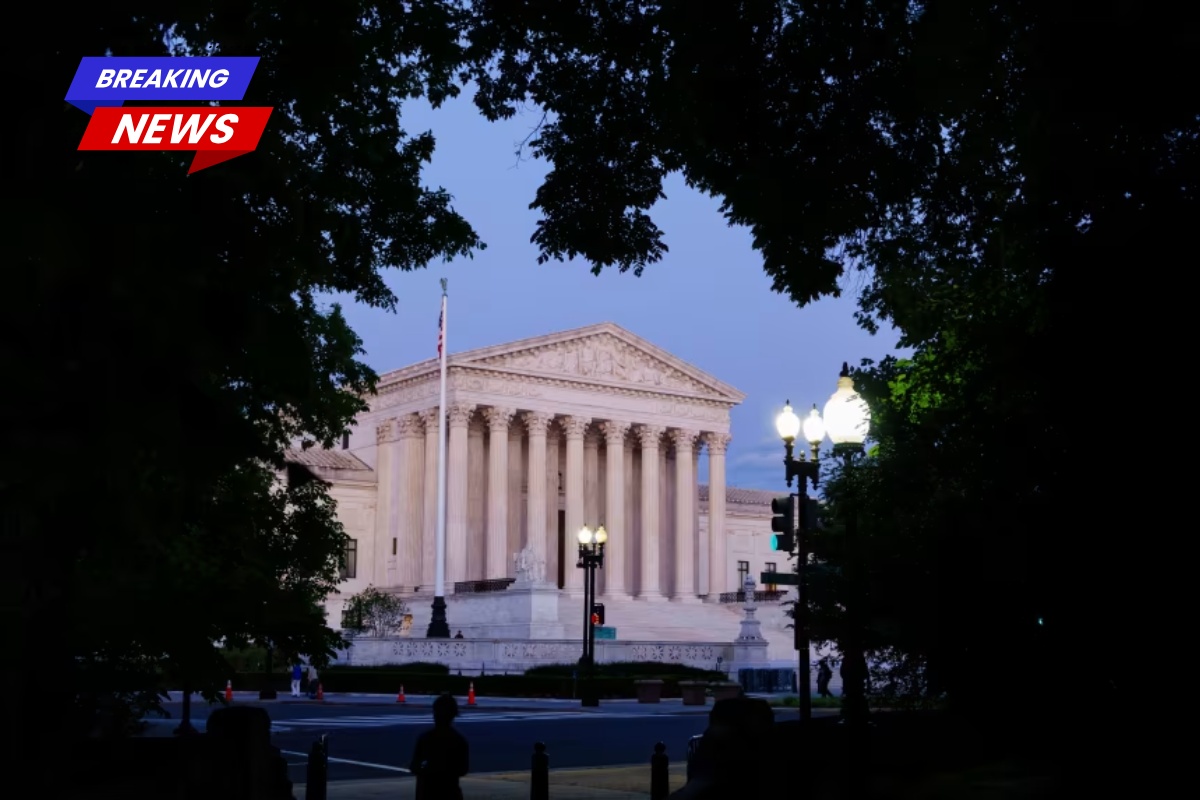
The U.S. Supreme Court has once again placed Alabama’s congressional map at the center of a major voting rights debate, issuing a decision that could significantly affect minority representation and future redistricting challenges across the country.
The ruling comes after years of legal battles over whether Alabama’s congressional districts unfairly dilute the voting power of Black residents.
Supreme Court Sides With Alabama in Redistricting Fight
The U.S. Supreme Court issued a late-night decision allowing Alabama to move forward with a congressional map that has been the subject of intense legal disputes.
The ruling overturned a decision by a three-judge federal panel that had found Alabama’s latest redistricting plan intentionally discriminated against Black voters.
The lower court had previously ordered the state to maintain a map containing two districts where Black voters had a meaningful opportunity to elect candidates of their choice.
The Supreme Court’s decision now clears the way for Alabama to use a map containing only one such district.
Long Legal Battle Over Congressional Maps
The case stems from Alabama’s congressional redistricting process following the 2020 census.
Although Black residents make up approximately 27% of Alabama’s population, the state originally drew a congressional map with only one majority-Black district out of seven total congressional districts.
Civil rights groups challenged the map, arguing that it diluted Black voting power and violated federal voting rights protections.
A federal court agreed and ordered Alabama to create a second district where Black voters would have a realistic opportunity to elect their preferred candidate.
The Supreme Court initially upheld that requirement in a 2023 ruling.
Federal Judges Previously Found Intentional Discrimination
The three-judge federal panel reviewing the case repeatedly concluded that Alabama’s maps disadvantaged Black voters.
In a lengthy opinion issued earlier this year, the court found that lawmakers were aware their proposed district boundaries would reduce Black voting influence.
The panel stated that the Legislature intentionally adopted a plan that diluted the ability of Black residents to participate effectively in the political process.
Notably, the panel included judges appointed by both Republican and Democratic presidents, demonstrating bipartisan agreement on the findings.
Despite those conclusions, the Supreme Court ultimately disagreed.
Supreme Court Emphasizes Legislative Good Faith
The Supreme Court’s unsigned opinion focused heavily on the principle that courts should presume lawmakers acted in good faith when drawing district boundaries.
According to the majority, the lower court failed to give sufficient weight to that presumption.
The justices argued that disagreement with previous court orders should not automatically be interpreted as evidence of discriminatory intent.
The ruling reflects a growing emphasis by the Supreme Court on requiring challengers to prove intentional discrimination rather than relying primarily on the effects of a redistricting plan.
This shift could make future voting rights challenges more difficult.
Liberal Justices Strongly Dissent
The court’s three liberal justices sharply disagreed with the majority’s decision.
Justice Sonia Sotomayor, writing for the dissent, accused the court of rewarding Alabama for repeatedly resisting judicial rulings.
She argued that the lower court had carefully reviewed extensive evidence before concluding that discrimination occurred.
The dissent also warned that the ruling could weaken protections against racial vote dilution and make it harder for minority voters to challenge unfair district maps.
According to the dissenting justices, the record clearly supported the lower court’s findings.
Election Impact Could Be Significant
The decision could have major political consequences in Alabama.
The court-approved map is expected to benefit Republicans by reducing the likelihood that a second Democrat will be elected from the state.
Under the remedial map used during recent elections, Alabama elected two Black members of Congress.
Political analysts believe the new map will likely result in six Republican representatives and only one Democrat representing Alabama in Congress.
The timing of the ruling also creates logistical challenges because election preparations are already underway.
Broader Implications for Voting Rights
Many observers view the Alabama case as part of a broader shift in voting rights law.
Recent Supreme Court decisions have increasingly narrowed the standards used to evaluate claims of racial discrimination in redistricting.
Under the court’s latest approach, challengers must provide stronger evidence that lawmakers intentionally discriminated against minority voters.
Critics argue that proving intent is often far more difficult than demonstrating the practical impact of district boundaries.
Supporters, however, contend that states should receive greater deference when making political and geographic decisions during redistricting.
Historical Context Remains Important
The case carries particular significance because of Alabama’s history in the civil rights movement.
The state played a central role in the events that led to the passage of the Voting Rights Act of 1965, including the violent attacks on civil rights marchers during the Selma campaign.
For decades, federal courts closely monitored voting practices in Alabama due to documented discrimination against Black voters.
That history has frequently been cited in modern voting rights litigation involving the state.
The latest ruling adds another chapter to the long-running debate over representation, race, and electoral fairness.
Future Legal Challenges Likely
Voting rights advocates are expected to continue challenging redistricting plans in states across the country.
However, legal experts say the Alabama ruling may make those efforts more difficult moving forward.
The decision reinforces a higher legal standard for proving discriminatory intent and strengthens the presumption that lawmakers acted appropriately when drawing district lines.
As a result, future cases could face greater obstacles in federal courts.
The ruling is likely to influence redistricting disputes well beyond Alabama.






