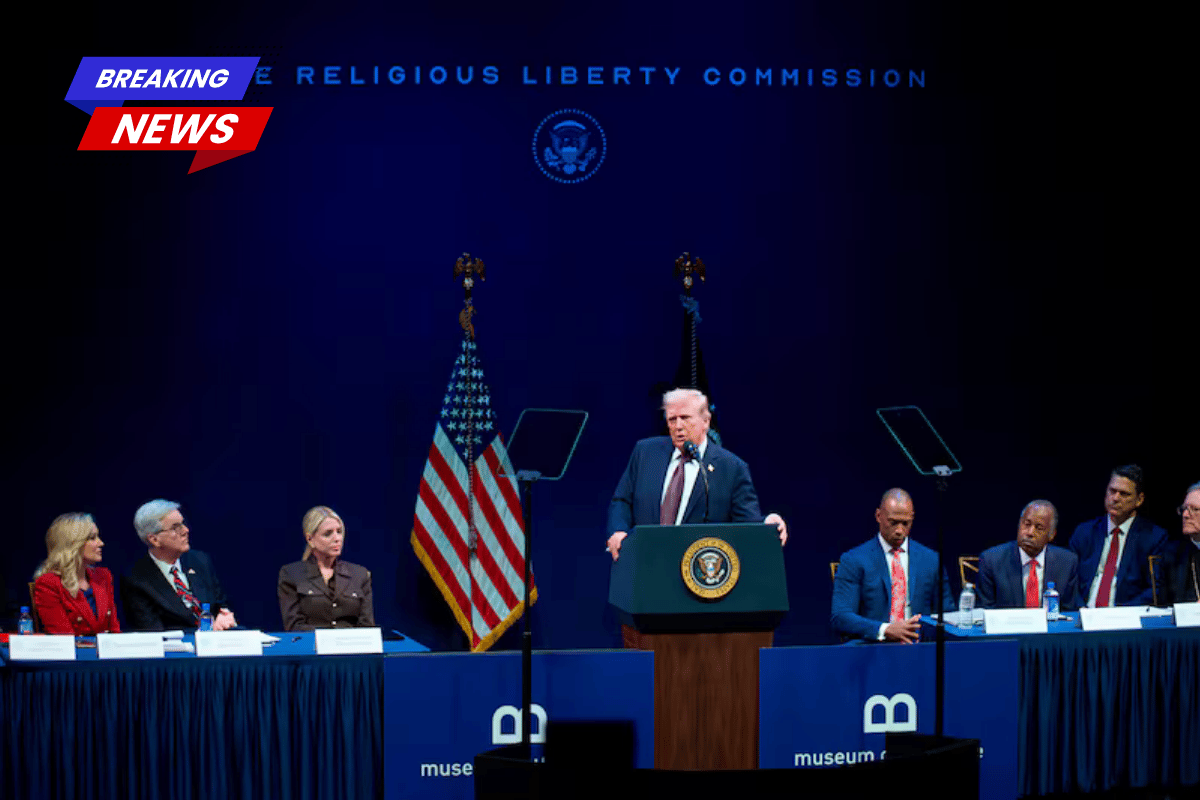
A Presidential advisory panel formed by Donald Trump on religious liberty is making waves with its proposed recommendations, which focus heavily on expanding religious expression in public spaces, supporting faith-based organizations, and challenging legal frameworks that restrict religious freedoms.
These recommendations, discussed during the commission’s April meeting, reflect the views of many conservative Christian and Catholic activists, though they have faced significant criticism for their one-sided perspective.
Key Proposals by the Commission
Among the notable proposals put forward by the commission are calls for:
- Presidential Medal of Freedom for a baker who refused to create a wedding cake for a same-sex couple.
- Court interventions by the Department of Justice on behalf of Amish parents fighting New York vaccine requirements.
- A proposal for a federal hotline with an automated message stating, “There is no separation of church and state.”
Additionally, some commissioners advocated for expanded opportunities for religious-based exemptions in areas like labor law, healthcare mandates, and classroom teachings.
The commission also recommended efforts to promote religious expression in public schools, which aligns with the growing conservative Christian calls to bring more faith into government and educational systems.
Criticism of the Commission’s Narrow Focus
Critics of the commission argue that it reflects a one-sided perspective that primarily represents conservative Christian viewpoints, largely ignoring other religious communities and more diverse perspectives.
The commission, composed largely of Christian clerics and conservative commentators, has been accused of promoting an agenda that undermines the separation of church and state.
A lawsuit filed by a progressive interreligious coalition challenges the commission’s composition, claiming that it does not comply with federal law requiring advisory panels to reflect diverse viewpoints.
The plaintiffs argue that the commission’s emphasis on a Judeo-Christian or Christian vision of America is problematic, especially as the commission’s meetings have often been held at the Museum of the Bible in Washington, an institution with Christian leadership.
Debates on Church-State Separation
One of the most controversial statements came from the commission chair, Dan Patrick, who openly challenged the concept of church-state separation.
He claimed, “We need to say there is no separation of church and state,” despite this principle being embedded in Supreme Court precedent. Patrick’s statements have raised concerns among critics who worry that such rhetoric undermines constitutional protections.
Proposals for Schools, Workplaces, and Religious Groups
Other recommendations from the commission include:
- Postings of religious expression rights in schools and workplaces.
- Restoration of full pay and pensions for military service members discharged for refusing the COVID-19 vaccine.
- Expanding federal funding to Catholic Charities and other religious groups without compromising their teachings on the family.
- Providing humane treatment to Catholic immigrants in detention, ensuring access to sacraments, and protecting worship services from being disrupted by immigration enforcement actions.
Additionally, some commissioners, like Bishop Robert Barron, called for religious groups to have greater access to federal funding while maintaining their religious principles. Others, such as Kelly Shackelford of the First Liberty Institute, advocated for a shift in power to citizens by requiring governments to pay legal fees for those challenging religious liberty cases.
Controversies and Interlocking Trump Initiatives
The commission’s proposals are part of a broader set of Trump-era initiatives, including the Task Force to Eradicate Anti-Christian Bias, which claimed discrimination against Christians under President Joe Biden’s administration. Critics argue that these efforts focus on issues favored by conservative Christians and lack a comprehensive analysis of broader systemic discrimination.
Despite the controversies surrounding the commission, its influence persists, with several members scheduled to participate in a prayer event for the nation’s 250th birthday on May 17, and a recent Bible-reading marathon largely organized at the Museum of the Bible.