
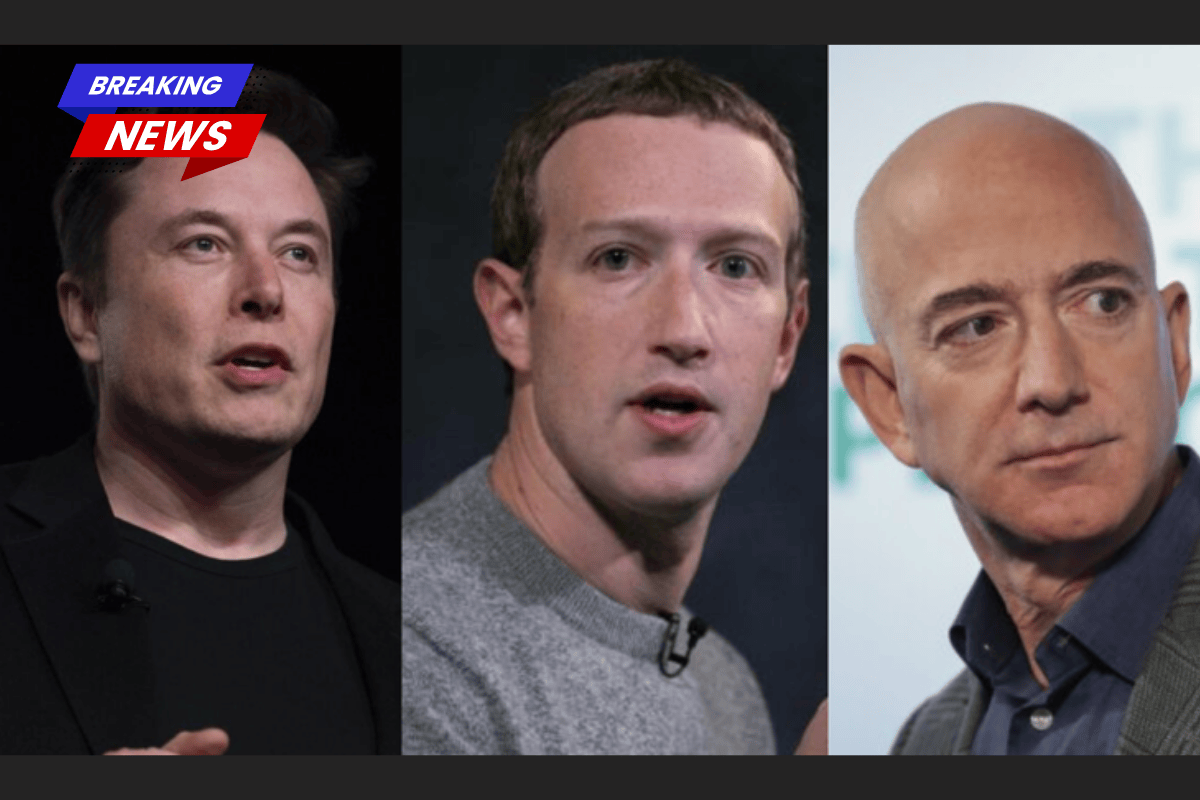
In a single day, Mark Zuckerberg, Jeff Bezos, and Elon Musk saw their combined wealth plummet by $42.6 billion following a fresh wave of tariffs introduced by U.S. President Donald Trump. The announcement of “discounted” reciprocal tariffs sent shockwaves through global markets, sparking a dramatic selloff across U.S. stock indexes, leading to one of the worst trading days since the COVID-19 pandemic.
The Impact on Tech Billionaires
According to data from Forbes, Mark Zuckerberg, the CEO of Meta (formerly Facebook), suffered the largest individual loss. His net worth dropped by $17.9 billion on Thursday, April 3. Following Zuckerberg was Amazon’s founder Jeff Bezos, who saw his wealth fall by $16 billion, while Tesla CEO Elon Musk experienced a decline of $8.7 billion.
The tariffs, which were announced by President Trump under the International Emergency Economic Powers Act (IEEPA), led to massive declines in major U.S. stock indexes, with investor panic reflected in the sharp selloff in both the tech sector and broader markets. The losses were especially severe for tech giants, who are particularly sensitive to changes in global trade dynamics.
Other Tech Leaders Hit Hard
In addition to the major losses by Zuckerberg, Bezos, and Musk, several other tech leaders also saw significant declines in their wealth. Nvidia CEO Jensen Huang experienced a $7.4 billion drop in his net worth, while Microsoft founder Bill Gates saw a more modest loss of $774 million.
Alphabet co-founders Larry Page and Sergey Brin lost $4.9 billion and $4.6 billion, respectively. Alphabet CEO Sundar Pichai also faced a decline, though significantly smaller, with his wealth dropping by $18 million. Apple CEO Tim Cook saw his net worth decrease by $68 million.
U.S. Market Plunge
The U.S. stock markets saw significant drops after the tariff announcement, leading to the lowest market close since 2022. The S&P 500 fell by 275.05 points (4.85%), closing at 5,395.92. The Nasdaq Composite suffered an even larger decline, dropping 1,053.60 points (5.99%) to 16,547.45, while the Dow Jones Industrial Average closed 1,682.61 points (3.98%) lower at 40,542.71.
The Tariff Controversy
The sharp market reaction has raised concerns over the economic impact of Trump’s tariff policy, with analysts predicting that legal challenges could soon arise. The tariffs were imposed under the IEEPA, a law that has never been used before for such sweeping changes to U.S. economic policy.
According to UBS analysts, the move could face substantial legal pushback, and businesses may intensify their lobbying efforts to ease the tariffs. Political pressure to reduce the tariffs could also mount, especially as economic costs rise due to the trade restrictions.
UBS analysts suggested that there’s a 50% probability that the tariffs will be reduced from the levels initially announced by the President. Treasury Secretary Scott Bessent also indicated that the tariffs announced could be the “high end of the number”, suggesting that countries may take steps to negotiate a reduction.






