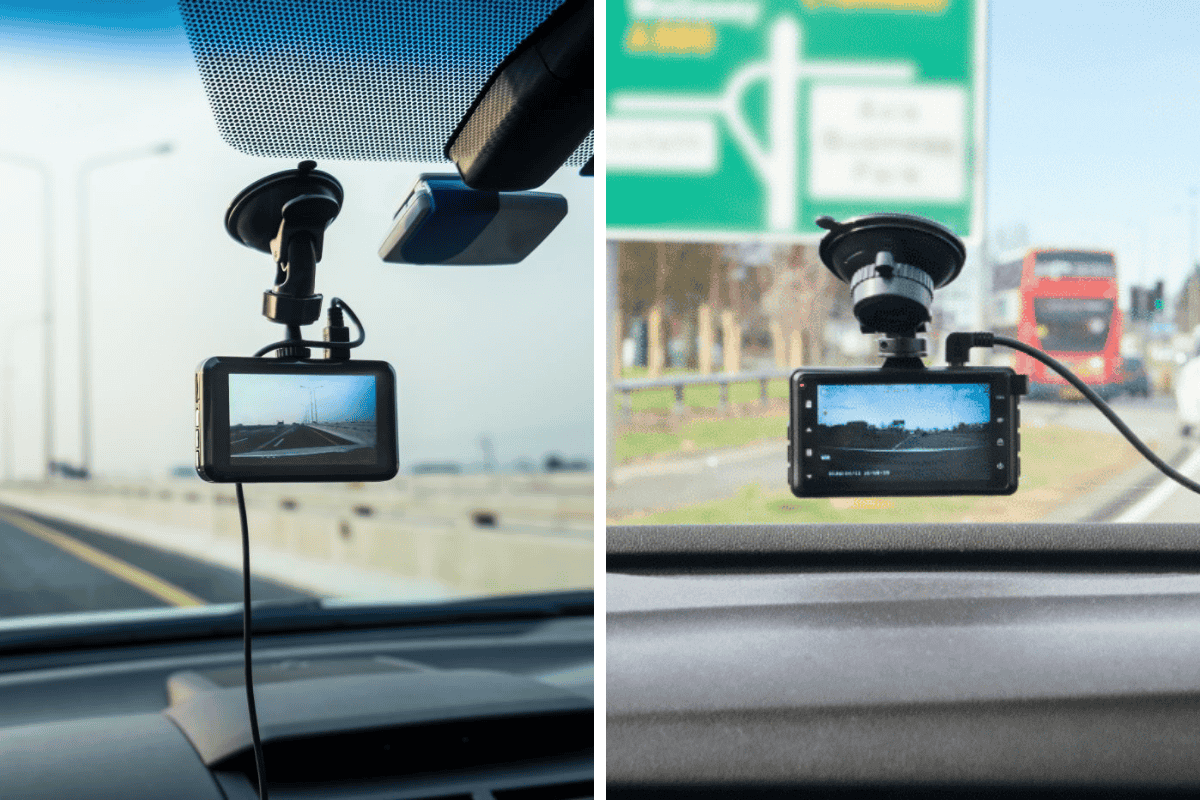
Dash cams are legal in Kansas with minimal restrictions. They must not substantially obstruct the driver’s view, allowing mounting on the dashboard or a small windshield area, under a one-party consent rule for audio.
Mounting Rules
Kansas Statute K.S.A. 8-1741(a) prohibits any nontransparent material on the windshield, side wings, or windows that substantially obstructs, obscures, or impairs the driver’s clear view of the highway.
Dash cams qualify as allowed if placed on the dashboard or a limited windshield spot (e.g., behind the rearview mirror) without meaningfully hindering vision; “substantial” obstruction is key, so low-profile devices comply.
Avoid central windshield placement to prevent tickets; dashboard mounts are safest for fleets and personal use.
Audio Recording Guidelines
Kansas follows one-party consent for audio under K.S.A. 21-6101, meaning you (as the driver) can record conversations without notifying others, as long as no reasonable privacy expectation exists.
Public road recordings are fine, but inform passengers (via sticker or verbal notice) for courtesy and to bolster admissibility; disable audio if privacy concerns arise.
Police interactions can be recorded openly, aiding accountability without consent issues.
Video Privacy Limits
Video in public spaces like highways is unrestricted, as no privacy expectation applies; footage captures roads and vehicles legally.
Interior cabin recording is permissible for personal use but avoid private property without permission; blur faces when sharing online to respect identities.
Law enforcement vehicle cams are separate under K.S.A. 45-254, treated as criminal records—not applicable to civilians.
Court and Insurance Use
Dash cam footage is generally admissible in Kansas courts if authenticated (e.g., timestamps, chain of custody), as shown in 2019 cases using police cams for accidents or stops.
Insurance accepts it for claims, potentially reducing premiums or clarifying fault; some carriers offer discounts for equipped vehicles.
In disputes, unaltered video strengthens cases but can backfire if showing violations—retain originals securely.
Installation Best Practices
Route cables along headliner to avoid pedals/airbags; test for blind spots pre-drive.
Choose models with loop recording, GPS, and G-sensors for events.
Enforcement and Penalties
Violations like obstruction fall under traffic infractions: $50-$200 fines, possible points; rare for compliant cams.
Audio misuse could invoke wiretap misdemeanor (up to 1 year jail, $2,500 fine), but one-party rule protects most uses.
Police cannot seize cams without warrant during stops; request footage politely if needed.
Benefits for Kansas Drivers
Footage deters theft (many have parking modes), proves innocence in hit-and-runs, and supports insurance amid rising rates (Kansas average $1,800/year).
Fleets gain safety coaching; personal users document rural road incidents common in Kansas.
SOURCES:
- https://www.ddpai.com/blog/dash-cam-laws/
- https://www.expertmarket.com/dash-cams/dash-cam-laws-by-state