As the 40th anniversary of the Tennessee Williams/New Orleans Literary Festival approaches this weekend (March 25-29), memories of the festival’s early years come rushing back. I recall a moment during the festival when a fiery debate unfolded about the burial site of Tennessee Williams, the famous playwright.
Years ago, while exploring Calvary Cemetery in St. Louis, Missouri, his hometown, I had an afternoon dedicated to finding his final resting place. It was not easy, as Williams’ grave was somewhat elusive, but it led to a deeper connection with his story and his complex relationship with the city.
The Debate at the Festival: Dakin Williams and St. Louis
The annual festival has featured many of Williams’ contemporaries discussing his life and work. One of the recurring topics was the decision made by his brother, Dakin Williams, to bury Tennessee in St. Louis—a city that Tennessee himself had strongly disliked. “Loathe” was often one of his terms for the town.
Tennessee was much more at home in places like New Orleans, Key West, and New York City, where he lived and worked. However, as the surviving sibling, it was Dakin who had the final say in where his brother would be laid to rest.
Dakin was a regular presence at the festival and appeared on various panels. His involvement often stirred the crowd, especially due to his flashy appearance—gold jackets, loud pants, and even a security guard. The tension over his decisions, particularly regarding Tennessee’s burial, made Dakin the ultimate antagonist.
After years of criticism, the festival put together a panel titled “I Remember Tennessee” with Dakin and some of his critics. The atmosphere was tense as the audience awaited answers. It didn’t take long for someone to ask, “Dakin, why did you bury your brother in St. Louis?”
His response was clear and firm: “Because that’s where his family is buried.” His parents and sister, Rose, were also laid to rest there. It was, in his view, the appropriate place.
The Unscripted Moment of Resolution
Then, in an unexpected turn, one of Dakin’s harshest critics leaned into the microphone and said, “You know, he’s right.” A moment of dramatic resolution unfolded on stage as the entire panel agreed. Dakin’s decision was validated.
That was one of the most memorable moments at the festival, where personal family conflicts were openly discussed and resolved in front of an audience. It showed the power of family dynamics and the lasting impact they can have on a legacy.
The Search for Tennessee Williams’ Grave
Years after the festival, I visited St. Louis again and was taken on a tour of Calvary Cemetery by a local guide. The cemetery is beautiful and home to many notable figures, including General William Tecumseh Sherman. But finding Tennessee Williams’ grave was no simple task.
Despite the directions we received from a cemetery employee, the location remained elusive. Finally, after much searching and a few phone calls, we found the spot—a simple family plot marked with a modest tombstone:
Tennessee Williams
1911-1983
Poet, Playwright
The Violets in the Mountains
Have Broken the Rocks
Camino Real
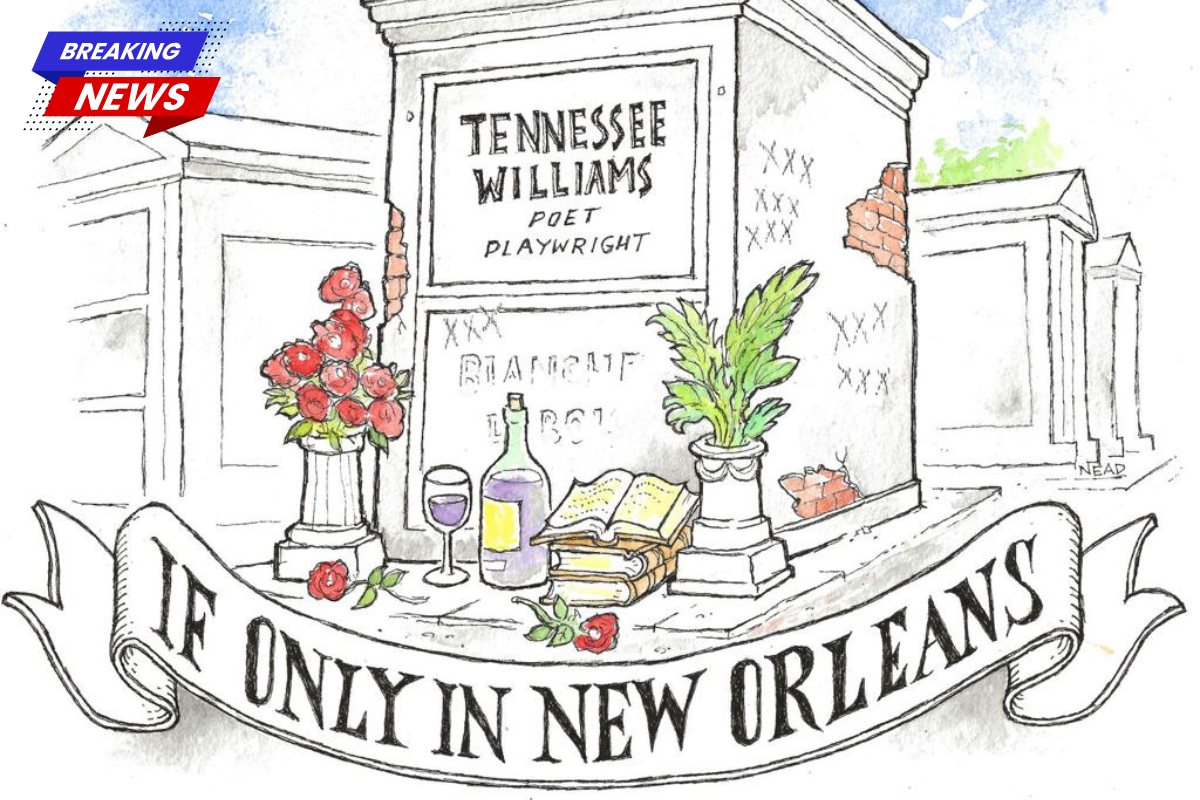
It was a humble resting place, far from the touristy embellishments one might expect in New Orleans, where Williams had a special connection. In New Orleans, perhaps his grave would have been more prominent—maybe even adorned with painted Xs, like the nearby tomb of Marie Laveau.
What If Tennessee Williams Had Been Buried in New Orleans?
Had Tennessee Williams been buried in New Orleans, his grave might have been a tourist attraction, perhaps in St. Louis Cemetery No. 1, near Voodoo Queen Marie Laveau. It would certainly have been more public and well-known. However, Williams’ grave in St. Louis, near his family, feels like a private tribute to his roots and the struggles of his life.
At least in St. Louis, he was not far from General Sherman, whose commanding presence might seem more fitting than the flamboyant spirit of New Orleans. Yet, there would always have been the pull of Marie Laveau nearby in the Crescent City.
Tennessee Williams and His Family’s Legacy
The story of Tennessee Williams’ final resting place is a reminder of the complexities of family ties, legacies, and the places that shape us. While his love for New Orleans and other places was clear, Dakin’s decision to bury him in St. Louis served as a lasting tribute to the Williams family’s history.
For more insights on the Tennessee Williams/New Orleans Literary Festival, or to learn about the writer’s legacy, visit their official site for updates and events.